Predictive analytics is no longer reserved for large enterprises with massive data teams. Today, businesses of all sizes rely on it to forecast demand, spot risks early, and uncover revenue opportunities. The challenge is not whether to adopt predictive analytics. The real challenge is choosing a solution that actually delivers results.
Many platforms promise powerful algorithms and advanced AI capabilities. Yet without the right features, those promises rarely translate into measurable business impact. In this guide, we will explore the key features to look for in a predictive analytics solution so you can choose a platform that drives real business growth and long term ROI. Let’s jump right in!
1. Scalability and Performance
Your data will grow. Your customer base will grow. Your business questions will become more complex. The solution you choose must be able to grow with you.
Look for platforms that can handle increasing data volumes without slowing down. Cloud compatibility is also important since it allows flexible storage and computing power. A strong system should process large datasets and run complex models efficiently.
Performance under real time or near real time conditions is equally important for industries like retail, fintech, and logistics where timing directly impacts revenue.
2. Seamless Integration Capabilities
A predictive analytics solution should not operate in isolation. It must connect smoothly with your existing systems such as ERP, CRM, marketing platforms, or BI tools.
Check whether the platform offers robust APIs and ready-made connectors. Integration should be straightforward rather than requiring heavy custom development.
When data flows easily between systems, insights become actionable. Teams can apply predictions directly within their daily workflows instead of switching between disconnected tools.
3. Customization and Model Flexibility
Every business has unique challenges. A one size fits all model rarely works for long.
Choose a solution that allows customization of models, parameters, and workflows. You should be able to tailor predictions to specific use cases such as churn prediction, fraud detection, or demand forecasting.
Flexibility also means the ability to refine and retrain models as your data evolves. Markets change. Customer behavior shifts. Your predictive system should adapt without forcing a complete rebuild.
4. Real Time and Near Real Time Predictions
In many industries, speed makes the difference between profit and loss. Real time predictions can help detect fraud instantly, adjust pricing dynamically, or personalize customer experiences on the spot.
A strong predictive analytics solution should support streaming data and deliver low latency predictions when required. Even if your current use cases do not require real time outputs, having that capability ensures you are prepared for future needs.
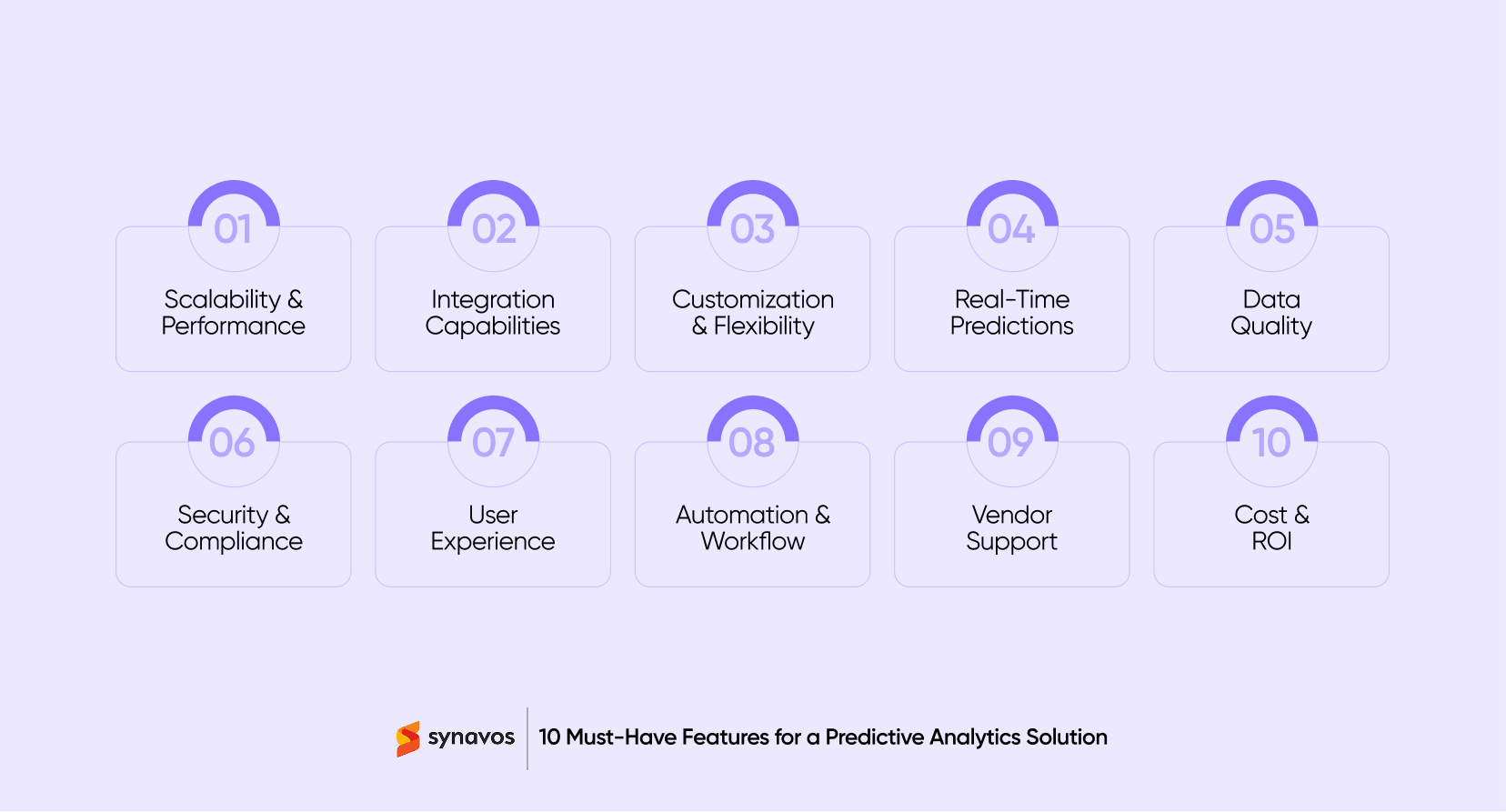
5. Data Quality Management Features
Predictive models are only as good as the data behind them. Poor data quality leads to unreliable forecasts and flawed decisions.
Look for built in tools that support data cleansing, validation, and preprocessing. The platform should handle missing values, inconsistent records, and duplicate entries efficiently.
Support for data governance and monitoring also helps maintain accuracy over time. Clean and well managed data strengthens trust in your predictions.
6. Security and Compliance Standards
Predictive analytics often involves sensitive business and customer data. Security cannot be an afterthought.
Ensure the solution provides strong encryption, secure data storage, and role based access controls. It should also comply with relevant industry regulations and data protection standards.
A secure infrastructure protects both your organization and your customers while reducing legal and reputational risks.
7. User Experience and Accessibility
Even the most powerful platform fails if teams struggle to use it. A good predictive analytics solution should offer intuitive dashboards and clear reporting tools.
Non technical stakeholders should be able to explore insights without relying entirely on data scientists. Self service capabilities encourage wider adoption and faster decision making.
When usability is prioritized, predictive insights become part of everyday business operations.
8. Automation and Workflow Support
Modern analytics platforms should automate repetitive tasks such as model training, retraining, and performance monitoring.
Look for features that trigger alerts, generate reports, and integrate predictions directly into operational systems. Automation reduces manual effort and ensures models remain accurate over time.
Continuous monitoring also helps identify performance drift so adjustments can be made before issues impact business results.
9. Vendor Support and Ecosystem
Technology alone does not guarantee success. The expertise behind the platform plays a major role.
Evaluate the vendor’s experience, industry knowledge, and track record. Strong onboarding support, documentation, and ongoing assistance can accelerate implementation and reduce risk.
A reliable predictive analytics partner will also help you scale your analytics strategy as your needs expand.
10. Cost, ROI, and Long Term Value
Pricing should be evaluated carefully, but it should not be the only deciding factor. Consider total cost of ownership including infrastructure, maintenance, training, and upgrades.
At the same time, estimate potential return on investment. Predictive analytics can drive revenue growth, cost reduction, efficiency improvements, and risk mitigation.
The right solution delivers measurable business value over time rather than simply offering the lowest upfront cost.
Conclusion
Choosing the right predictive analytics solution requires more than comparing feature lists. It demands a clear understanding of your business goals, data readiness, and long term strategy.
Focus on scalability, integration, customization, security, and usability. When these features align with your business needs, predictive analytics becomes more than a reporting tool. It becomes a reliable engine for smarter decisions and sustainable growth.
Build a Predictive Analytics Solution Designed for Your Business
Off the shelf platforms are not always enough. When your data, workflows, and goals are unique, you need a solution built around them.
At Synavos, we design and develop custom predictive analytics solutions tailored to your exact business requirements. From data architecture and model development to system integration and deployment, our team builds scalable systems that deliver accurate predictions and real business value.
Ready to turn your data into actionable insights? Connect with Synavos and let’s build a predictive analytics solution that drives real results for your business.