Choosing the right Odoo implementation partner can make the difference between a smooth ERP rollout and a project full of delays, unexpected costs, and low user adoption.
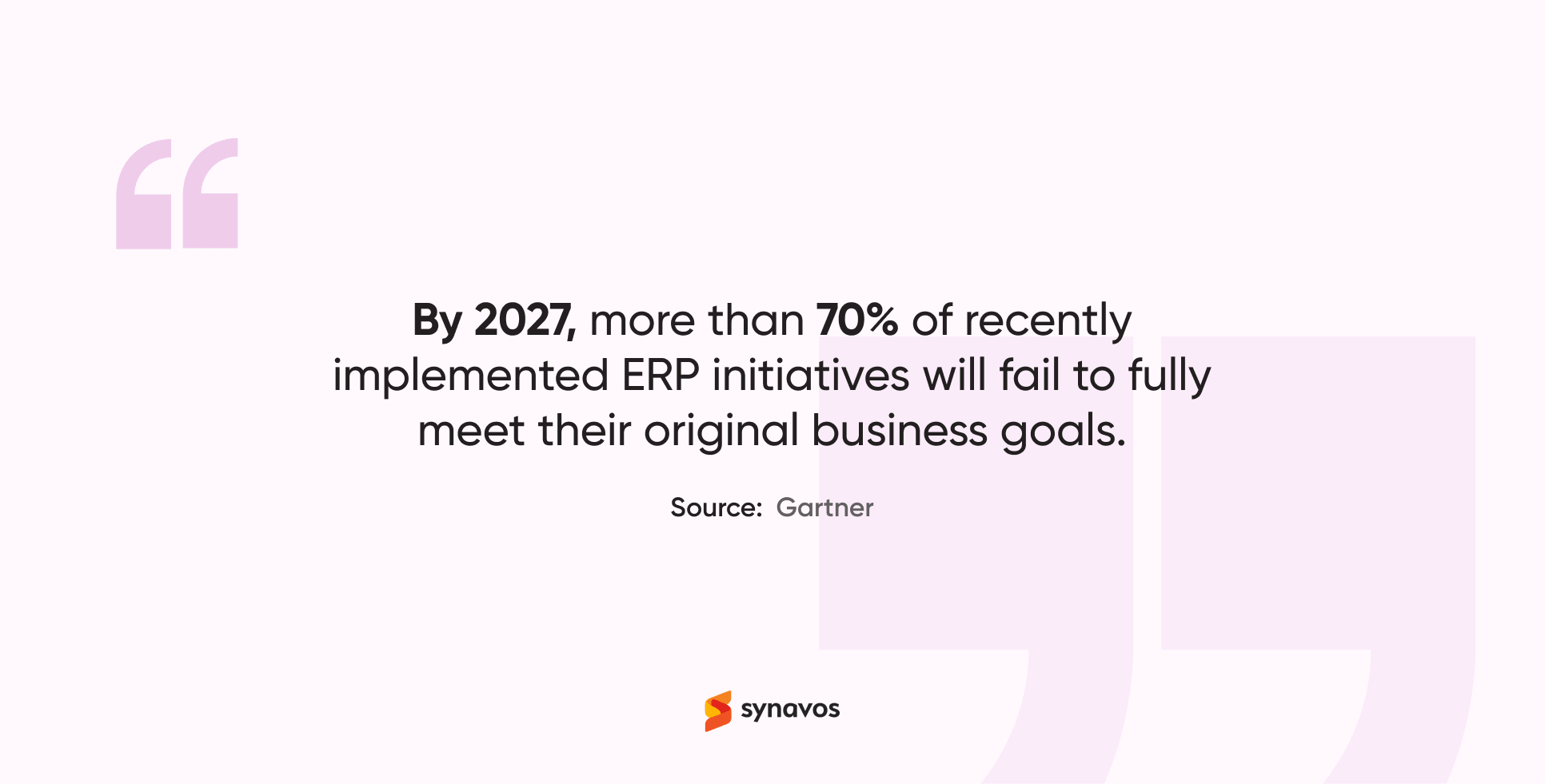
According to Gartner, “By 2027, more than 70% of recently implemented ERP initiatives will fail to fully meet their original business goals.” This makes partner selection one of the most important decisions businesses make before starting an ERP project.
Odoo is a powerful and flexible ERP platform, but successful implementation depends on much more than installing modules. Your partner needs to understand your business processes, configure the right workflows, manage data migration, train your teams, and support you after go-live. That is why businesses should not choose an Odoo partner based on price or promises alone. Before signing a proposal, you need to verify whether the partner has the right experience, process, technical capability, and long-term support model.
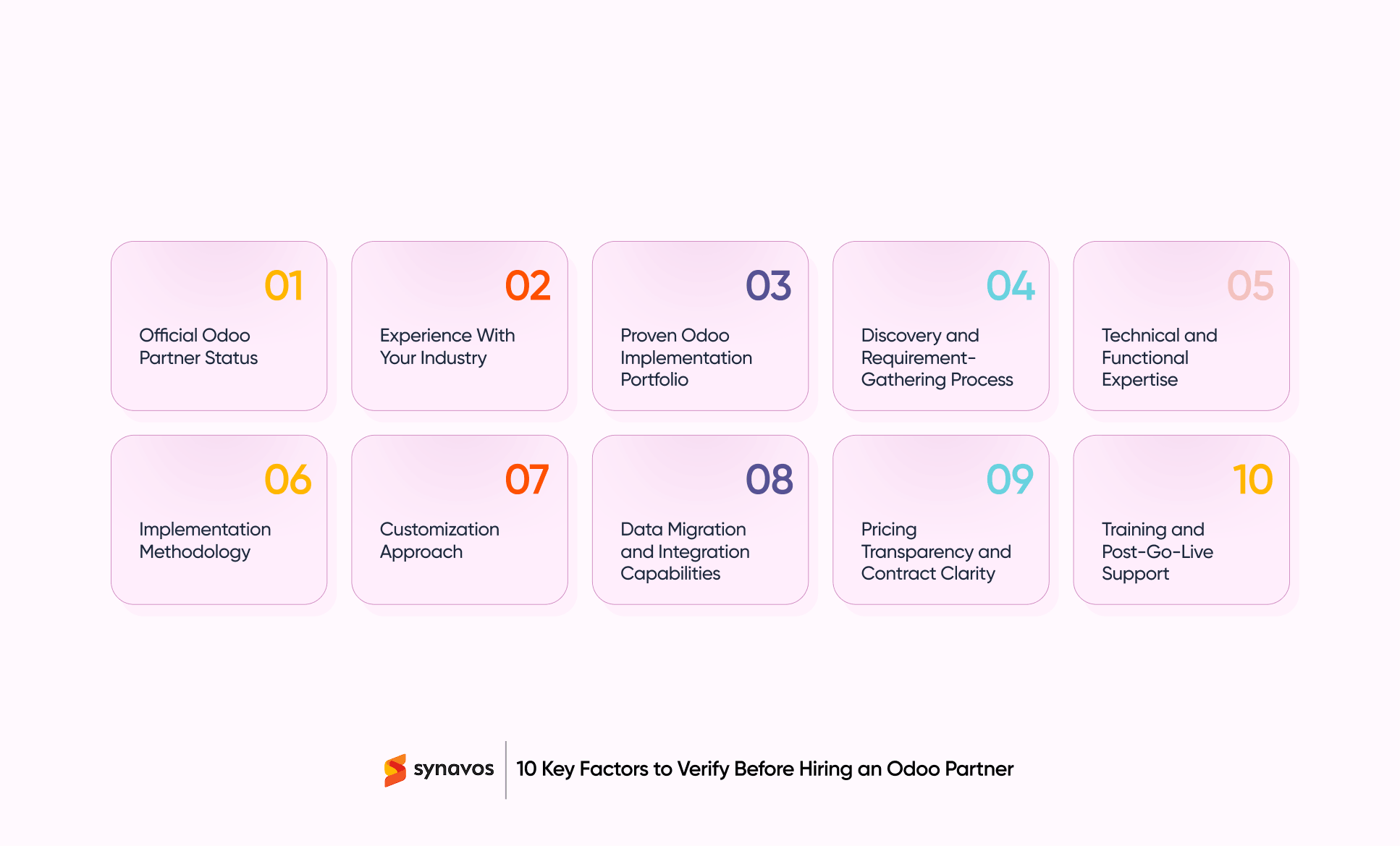
Before you commit to an Odoo implementation partner, use the following checklist to evaluate your options with confidence and choose a partner who can deliver real business value.
1. Official Odoo Partner Status
The first thing to verify is whether the company is an official Odoo partner. Official partner status shows that the company has a direct relationship with Odoo and meets certain standards related to training, experience, and customer success.
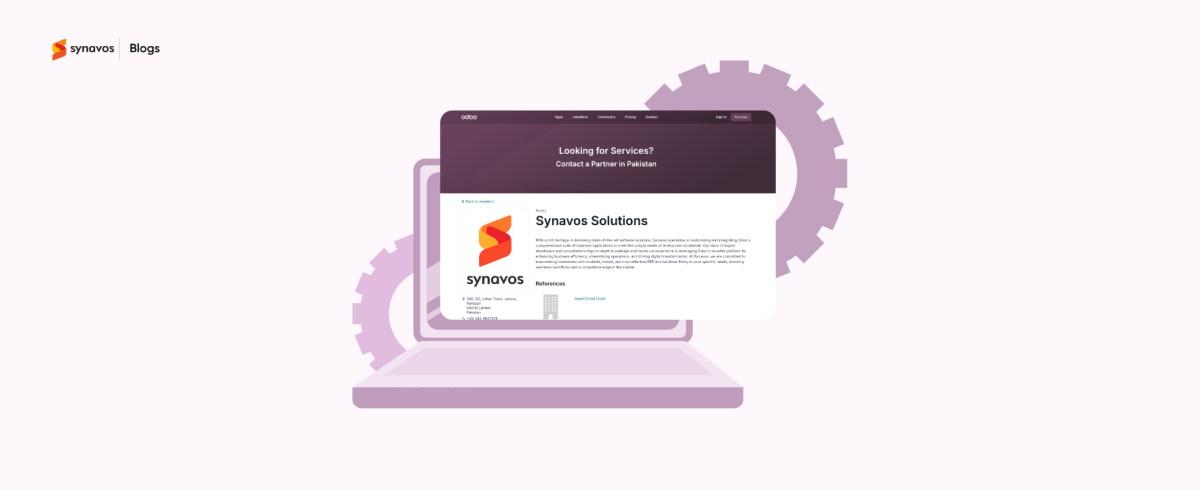
Odoo partners may also have different partner levels, such as Ready, Silver, and Gold. These levels can give you a useful indication of the partner’s experience, certified resources, and performance. For example, Synavos is an official Odoo Silver Partner, which strengthens its credibility for businesses looking for a verified implementation partner. However, partner status should not be the only factor in your decision. It should be the starting point of your evaluation.
What to Verify
- Are they listed as an official Odoo partner?
- What partner level do they hold?
- Do they have certified Odoo professionals?
2. Industry-Specific Experience
Every business has different workflows. A retail company may need strong inventory, POS, eCommerce, and accounting integration. A manufacturing business may require a bill of materials, production planning, quality checks, and warehouse management. A service-based company may focus more on CRM, projects, timesheets, invoicing, and reporting.
That is why industry-specific experience matters. A good Odoo implementation partner should understand your industry challenges and know how Odoo can support your business model.
Any trusted Odoo implementation partner like Synavos with relevant experience can identify risks earlier, recommend better workflows, and reduce the time spent explaining basic operational requirements.
What to Verify
- Have they implemented Odoo for businesses in your industry?
- Do they understand your operational workflows?
- Can they show examples of similar projects?
3. Proven Odoo Implementation Portfolio
A reliable Odoo implementation partner like Synavos should be able to show proof of past work. This may include relevant Odoo implementation case studies, client testimonials, project examples, references, or measurable business outcomes.
Do not only ask whether they have implemented Odoo before. Ask what kind of problems they solved, how complex the project was, which modules were involved, and what results the client achieved.
What to Verify
- Have they completed Odoo implementation projects?
- Have they worked with businesses of a similar size?
- What modules have they implemented?
- Can they explain measurable outcomes from previous projects?
4. Discovery & Requirement-Gathering Process
A successful Odoo implementation starts with proper discovery. Before proposing modules, timelines, or costs, the partner should take time to understand your business goals, current systems, pain points, reporting needs, and operational workflows.
This stage usually includes requirement workshops, process mapping, gap analysis, and solution planning. Without proper discovery, the project scope can become unclear, leading to delays, rework, and unexpected costs. A good partner will not rush into development. They will first document what your business needs and how Odoo should be configured to support those needs.
What to Verify
- Will they map your current business processes?
- Do they perform a gap analysis?
- Will they document functional and technical requirements?
- Do they provide a clear implementation roadmap after discovery?
5. Technical & Functional Expertise
Odoo implementation requires both technical and functional expertise. Technical skills are important for customization, integrations, data migration, hosting, security, and performance. Functional expertise is equally important for configuring workflows, mapping business processes, and ensuring the system supports real users.
A strong implementation partner like Synavos should have a balanced team that includes functional consultants, Odoo developers, project managers, QA specialists, and support resources.
What to Verify
- Do they have functional Odoo consultants?
- Do they have experienced Odoo developers?
- Can they handle custom modules and API integrations?
- Do they provide QA and testing support?
6. Implementation Methodology
Odoo implementation should follow a structured methodology. A clear process keeps the project organized, reduces confusion, and helps everyone understand what needs to happen at each stage.
However, a strong implementation methodology usually includes discovery, solution design, configuration, customization, data migration, testing, user training, go-live, and post-go-live support. Many businesses also prefer a phased or agile approach, especially when implementing multiple modules.
What to Verify
- What implementation methodology do they follow?
- How do they manage timelines and milestones?
- How do they handle testing and user acceptance?
7. Customization Approach
One of Odoo’s biggest strengths is flexibility. It can be customized to fit specific workflows, reports, approvals, and integrations. However, too much customization can also increase cost, complexity, and future upgrade challenges.
However, the right Odoo implementation partner, like Synavos, should not customize everything by default. They should first evaluate whether standard Odoo features can meet your requirements. Custom development should only be recommended when it adds clear business value.
What to Verify
- Do they prioritize standard Odoo features before customization?
- Can they explain when customization is necessary?
- Will they document all custom modules and changes?
8. Data Migration & Integration Capabilities
Data migration is one of the most sensitive parts of any ERP implementation. Your business may need to move customer records, product data, vendor information, opening balances, inventory data, invoices, sales history, employee records, or manufacturing data into Odoo. If data is not cleaned, mapped, tested, and validated properly, it can create serious issues after go-live.
Your partner should also be able to manage integrations with other systems, such as eCommerce platforms, payment gateways, accounting tools, shipping providers, CRM systems, POS systems, HR platforms, or third-party applications.
What to Verify
- Do they create a data migration plan?
- Will they clean, map, and validate your data?
- Do they run test migrations before go-live?
- Can they integrate Odoo with your existing systems?
9. Pricing Transparency and Contract Clarity
Odoo implementation pricing can vary based on modules, users, customization, integrations, data migration, training, hosting, and support. That is why pricing transparency is essential. A good partner should provide a clear proposal that explains what is included, what is excluded, how changes are handled, and what additional costs may apply. This helps prevent confusion later in the project.
For a detailed breakdown of Odoo implementation pricing, read our blog titled “Odoo Implementation Cost: A Complete 2026 Breakdown”.
Do not compare partners only by the lowest price. A vague low-cost proposal may become more expensive if it leaves out important work such as data migration, testing, training, or post-go-live support.
What to Verify
- Is the scope clearly documented?
- Does the proposal include cost breakdowns?
- Are assumptions and exclusions mentioned?
10. Training and Post-Go-Live Support
ERP success does not end at go-live. Your teams need to understand how to use Odoo in their daily work. Without proper training, employees may avoid the system, enter incorrect data, or continue relying on manual processes.
A reliable Odoo implementation partner should provide role-based training, user documentation, admin guidance, and post-go-live support. The first few weeks after launch are especially important because users may need help with real transactions, reporting, errors, or process adjustments.
What to Verify
- Do they provide role-based user training?
- Will they create user documentation?
- Is there a post-go-live support period?
- What support channels are available?
- Can they help with future upgrades and improvements?
Red Flags to Watch Before Hiring an Odoo Partner
Even if a partner sounds confident, there are warning signs you should not ignore. These red flags may indicate weak planning, poor delivery capability, or a higher risk of project failure. Watch out for an Odoo implementation partner who:
- Gives a quote without proper discovery
- Promises an unrealistic go-live timeline
- Cannot show relevant Odoo case studies
- Avoids detailed pricing discussions
- Does not explain the change request process
- Pushes heavy customization too early
- Has no clear data migration plan
- Does not offer user training
- Has no dedicated project manager
What Makes Synavos a Trusted Odoo Implementation Partner?
Synavos perfectly checks the Odoo implementation partner checklist discussed in this blog. Being the best Odoo company in Pakistan, Synavos brings the credibility, certified expertise, and implementation experience businesses need when choosing a reliable ERP partner.
With a proven track record of successful ERP implementations across KSA, UAE, and Pakistan, Synavos has successfully worked with businesses in manufacturing, retail, textile, and various other sectors. From requirement gathering and gap analysis to customization, integration, data migration, user training, and post-go-live support, Synavos follows a structured approach that helps businesses implement Odoo with confidence and long-term success.
Ready to choose an Odoo partner that checks every box? Connect with Synavos and start building an ERP system that fits your business, supports your teams, and scales with your growth.