Finding the right managed IT service provider isn’t just about comparing services and prices. When you work with an MSP, you’re trusting an outside team with parts of your IT environment that your business depends on every day.
This is especially important for businesses in Saudi Arabia, where growing reliance on cloud platforms, digital systems, and cybersecurity comes alongside industry-specific and regulatory requirements. The right provider should understand these needs while also being able to support your technology as the business grows.
So, how do you know which MSP is the right fit? This guide covers the key factors to consider when choosing a managed IT service provider in Saudi Arabia, from technical expertise and security to local support, SLAs, pricing, and scalability.
What Should You Look for in a Managed IT Service Provider in Saudi Arabia?
Choosing an MSP in Saudi Arabia means finding a provider that understands your technical needs and the local business environment. Here are the key factors to evaluate before making your choice.
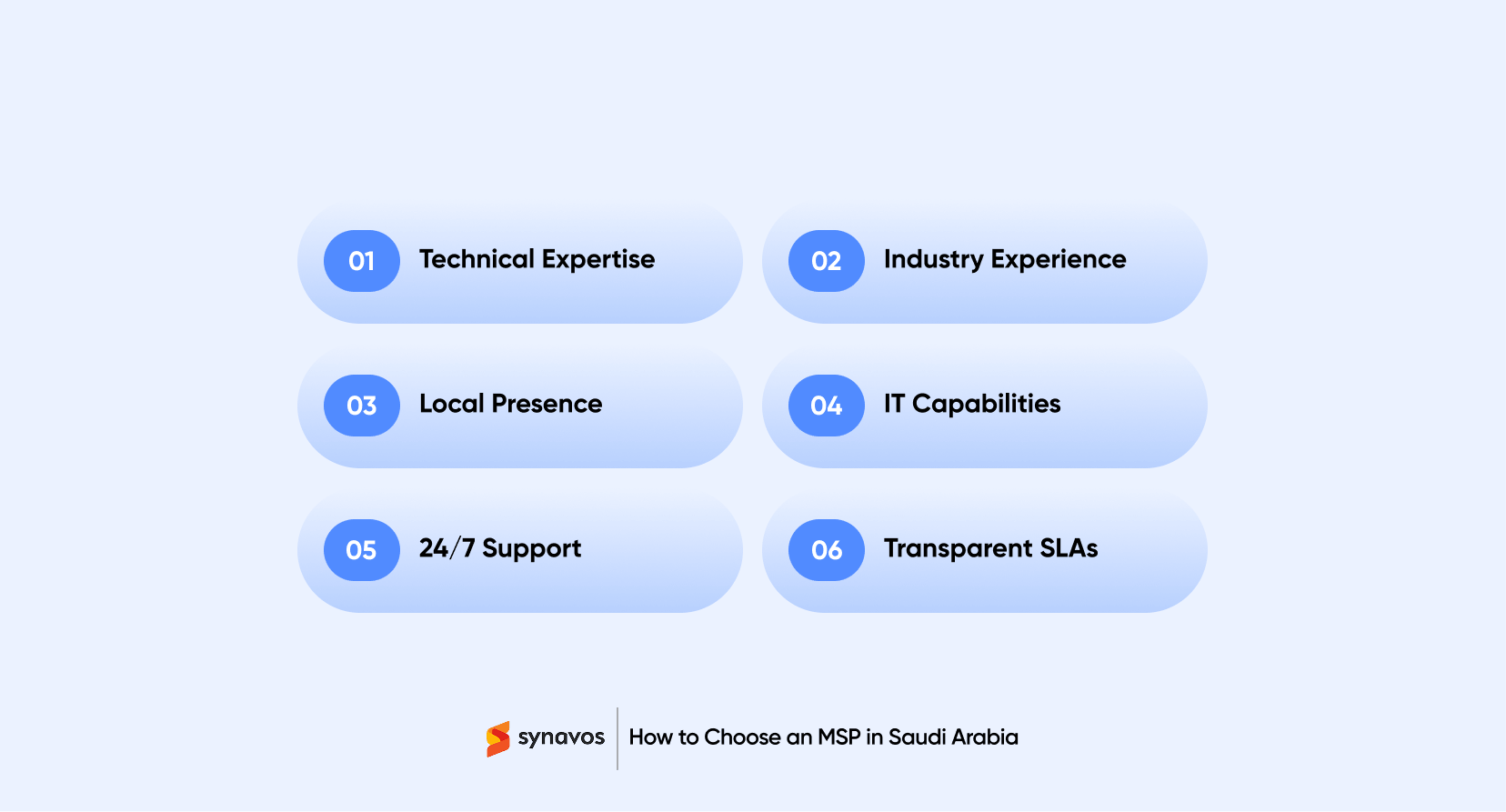
1. Technical Expertise and IT Experience
Start by looking at the provider’s technical capabilities. A good MSP should be able to manage the technologies your business already depends on while helping you handle new requirements as they arise.
Look for experience across IT infrastructure, networking, cloud platforms, cybersecurity, business applications, backup, and disaster recovery. It’s also worth asking whether the provider has worked with businesses of a similar size and complexity.
2. Industry Experience in Saudi Arabia
IT requirements can vary significantly between industries. A healthcare organization may have very different security and data requirements from a manufacturing company, while a financial services business may have additional regulatory considerations.
For businesses in Saudi Arabia, an MSP with experience in your industry can bring a better understanding of these requirements from the start. Ask about similar businesses the provider has supported and the types of IT environments it has managed.
3. Local Presence and Support in Saudi Arabia
Local presence can make a real difference when you need support that goes beyond remote troubleshooting. A provider with teams in Saudi Arabia can also offer a better understanding of the local business environment and provide on-site assistance when required.
If your business may need on-site support, ask where the provider’s support teams are based, how quickly they can respond, and whether on-site assistance is included in your agreement.
4. Managed IT Services and Capabilities
Your IT requirements may start with basic support, but they can expand as your business grows. Instead of choosing a provider that only handles help desk issues, look at whether it can support your wider IT environment.
This may include infrastructure and network management, cloud services, cybersecurity, 24/7 monitoring, backup, disaster recovery, and ongoing IT consulting. Having these capabilities under one provider can simplify IT management and give your business room to scale.
5. 24/7 IT Support and Monitoring
Ask exactly what the provider means by 24/7 support. Does it actively monitor your infrastructure around the clock, or is someone simply available to answer calls after business hours?
Find out which systems are monitored, how alerts are handled, and what happens when a critical issue occurs outside normal working hours. This is particularly important when your business depends on systems that need to remain available beyond standard office hours.
6. SLAs for Managed IT Services
An SLA should clearly define what you can expect from your MSP. It should cover response times, support availability, escalation procedures, and how different types of incidents are handled.
Don’t just look for a promise of “fast support.” Make sure the agreement clearly states what happens when a critical server goes down, an employee cannot access an essential application, or a security incident occurs.
This gives both sides a clear understanding of the service being provided and the level of support your business can expect.
Cybersecurity and Compliance for MSPs in Saudi Arabia
In Saudi Arabia, cybersecurity and regulatory requirements should be a key consideration when evaluating an MSP, especially for businesses in regulated industries or those handling sensitive information. Saudi Arabia has established cybersecurity frameworks and data protection requirements that can affect how organizations manage their IT environments and third-party providers.
When comparing MSPs, don’t simply ask whether they are “compliant.” Instead, understand which requirements apply to your organization and whether the provider has the processes, controls, and expertise to support them.
NCA Cybersecurity Controls
The National Cybersecurity Authority (NCA) has established cybersecurity controls covering areas such as cybersecurity governance, risk management, asset management, access control, and cybersecurity operations. The Essential Cybersecurity Controls (ECC 2-2024) apply to government entities and certain private-sector entities that own, operate, or host Critical National Infrastructure. NCA also maintains additional controls covering areas such as data, cloud, and operational technology.
If your organization falls within the scope of applicable NCA controls, ask an MSP how its services can support the controls relevant to your environment. This could include areas such as access management, vulnerability management, monitoring, incident response, data protection, and cybersecurity documentation.
SAMA Cybersecurity Requirements
For businesses regulated by the Saudi Central Bank, cybersecurity requirements become an important part of selecting an IT service provider. SAMA’s Cyber Security Framework establishes controls across areas including cybersecurity governance, risk management and compliance, security operations and technology, and third-party cybersecurity. It applies to SAMA-regulated member organizations, including banks, insurance and reinsurance companies, financing companies, credit bureaus, and financial market infrastructure.
If your business falls under SAMA’s scope, your MSP should be able to explain how its services and third-party practices support your organization’s cybersecurity requirements. Pay particular attention to how the provider handles access, monitoring, incident management, security responsibilities, and third-party risk.
Personal Data Protection Law (PDPL)
Cybersecurity isn’t the only consideration. Businesses operating in Saudi Arabia may also have obligations under the Personal Data Protection Law (PDPL) when they collect or process personal data.
This makes it important to understand how an MSP handles access to business and personal data, where relevant information is stored, who can access it, and how security incidents and data-related requests are managed. Your MSP should be able to clearly explain its role and responsibilities when it has access to systems or data containing personal information.
Evaluate the MSP’s Own Security Controls
Certifications alone don’t tell you how well an MSP will protect your business. When evaluating a managed IT service provider in Saudi Arabia, look at the security controls it has in place and how those controls are applied to your IT environment.
Ask the provider:
- Access Management: How is privileged access controlled and reviewed?
- Security Monitoring: How are systems monitored for suspicious activity?
- Vulnerability Management: How are vulnerabilities identified and addressed?
- Incident Response: How are security incidents detected, reported, and handled?
- Data Protection: How is business and customer data protected?
- Backup & Recovery: How are backups secured and recovery tested?
- Security Documentation: Can the provider demonstrate its relevant policies, procedures, and controls?
Consider the MSP’s Pricing and Service Model
Pricing is an important part of choosing a managed IT service provider in Saudi Arabia, but the monthly fee alone doesn’t tell you whether you’re getting good value. MSPs can structure their pricing differently, so compare both the cost and the services included before making a decision.
For Saudi businesses, managed IT services can typically range from a few thousand to tens of thousands of SAR per month, depending on factors such as company size, number of users and devices, locations, infrastructure complexity, cybersecurity requirements, and level of support. A small business with a largely cloud-based environment may have very different costs from a larger organization managing multiple offices, servers, and business-critical systems.
What Should Be Included in the Price?
When reviewing an MSP proposal, check whether the quoted price includes essential services such as:
- IT help desk and technical support
- 24/7 monitoring
- Cybersecurity and endpoint protection
- Network and infrastructure management
- Cloud management
- Backup and disaster recovery
- On-site support
- Software or licensing costs
Also check for additional charges. Some providers may charge separately for after-hours support, emergency work, on-site visits, additional users, new locations, or services outside the agreed scope.
Fixed Monthly vs. Pay-As-You-Go Pricing
A fixed monthly pricing model gives businesses more predictable IT spending because the scope and recurring cost are agreed in advance. Pay-as-you-go support charges based on individual services or incidents, which can work for businesses with limited IT requirements but may make costs harder to forecast.
When comparing MSPs, don’t simply choose the lowest quote. Compare what you’re paying, what you’re getting, and how the cost will change as your business grows.
For a detailed look at managed IT services pricing in Saudi Arabia, including common pricing models and the factors that affect costs, see our dedicated guide.
Red Flags to Watch for When Choosing an MSP in Saudi Arabia
Not every managed IT service provider will be the right fit for your business. When comparing MSPs in Saudi Arabia, look beyond the sales pitch and watch for signs that could create problems after you sign the agreement.
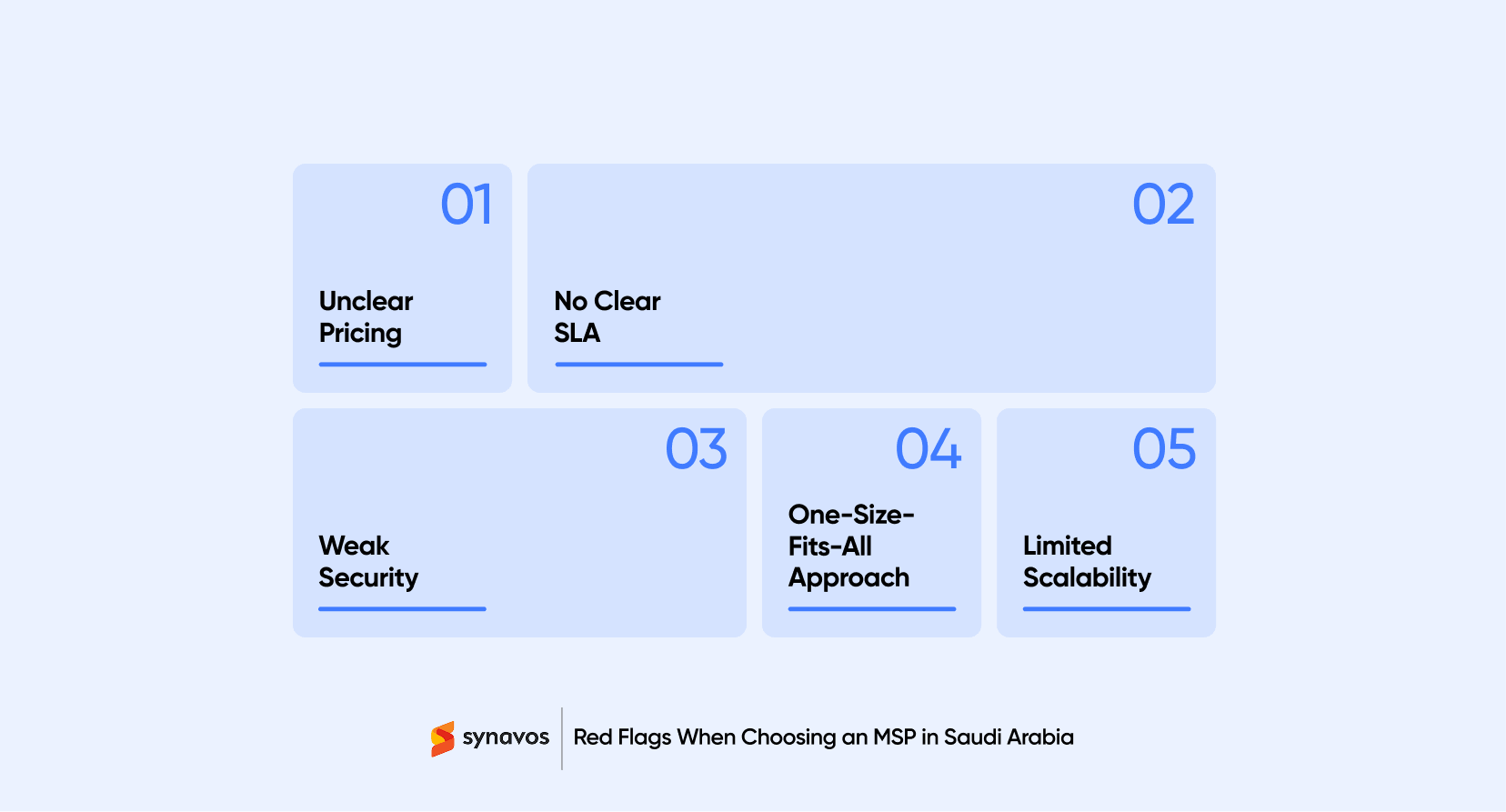
1. Unclear Pricing and Scope
Be cautious if a provider cannot clearly explain what is included in its monthly fee. A proposal should make it easy to understand what services you are paying for and which services may cost extra.
2. No Clear SLA
An MSP should be able to tell you how quickly it responds to different types of IT issues. If response times, escalation procedures, and support availability are vague, you may face uncertainty when a critical problem occurs.
3. Weak Security Practices
An MSP will often have access to sensitive systems and information, so weak security practices are a major concern. If a provider cannot clearly explain how it manages privileged access, monitoring, vulnerabilities, backups, and incidents, consider it a warning sign.
4. One-Size-Fits-All Approach
Your IT environment is unlikely to be identical to another business. Be cautious of providers that immediately recommend a standard package without first understanding your infrastructure, users, applications, security requirements, and business goals.
5. Limited Scalability
Your IT requirements will change as your business grows. If an MSP has limited capacity to support additional users, locations, applications, or infrastructure, you may eventually have to look for another provider.
How to Evaluate and Compare MSPs in Saudi Arabia
Once you’ve shortlisted a few providers, comparing them on price alone can make the decision harder rather than easier. Instead, assess each MSP against the areas that matter most to your business.
Start by documenting your current IT environment and identifying where you need support. Then compare providers based on their technical capabilities, Saudi market experience, security practices, service coverage, SLAs, pricing, and scalability.
It can also help to request a detailed proposal from each shortlisted provider. Make sure each proposal clearly explains the services included, support hours, response times, monitoring coverage, security responsibilities, additional charges, and contract terms.
Finally, ask for relevant client references or case studies. Speaking to businesses that have worked with the provider can give you a better idea of how it performs beyond what is written in a sales proposal.
Why Choose Synavos as Your Managed IT Service Provider in Saudi Arabia?
Finding the right MSP comes down to having a provider that can take care of your day-to-day IT while giving you the expertise and support to handle what’s ahead.
Based in Riyadh, Synavos provides managed IT services covering IT support, infrastructure, cloud, cybersecurity, monitoring, and backup. Our ISO 9001 and ISO 27001 certifications reflect our focus on service quality and information security.
With 24/7 IT monitoring and fixed monthly pricing, Synavos gives Saudi businesses a dedicated team to manage the technology they depend on every day, without the need to build a large internal IT function.
Looking for a managed IT partner in Saudi Arabia? Talk to Synavos about your IT requirements.
Final Thoughts
Choosing the right managed IT service provider is ultimately about finding the right balance between expertise, security, support, cost, and long-term fit. For businesses in Saudi Arabia, local experience and an understanding of the regulatory environment can be just as important as technical capabilities.
Take the time to compare providers beyond their sales proposals. The right MSP should give you confidence that your IT is being properly managed today while providing the flexibility to support your business as it grows.