A business chooses Odoo, signs with an implementation partner, and expects things to get easier. A few months later, the picture can look very different.
Deadlines have moved. Customizations have multiplied. Employees are still using Excel for work that was supposed to happen inside the ERP. Reports don’t quite match, and every new change seems to create another dependency.
At that point, it is easy to blame the software. But quite often, Odoo is not the real problem. The way it was implemented is.
Choosing the right Odoo partner in Pakistan is therefore less about finding someone who can install the system and more about finding a partner that understands what your business is trying to achieve with it.
This guide shows you what to ask, what evidence to request, and how to compare shortlisted partners without relying on sales promises.
What Makes a Good Odoo Partner in Pakistan?
A good Odoo partner should bring together Odoo expertise, business process knowledge, industry experience, technical skills, and long-term support. Knowing the software matters, but it is only one part of the job.
Your departments do not work alone. Sales affects inventory. Inventory affects purchasing. Purchasing affects finance. If you manufacture products, production adds another layer. Then there may be eCommerce, payments, logistics, banking, or other systems connected to the same flow.
So, an Odoo project cannot be treated as a list of separate technical tasks.
The right Odoo implementation partner in Pakistan should understand how work moves across departments, where delays happen, what can be improved, and where standard Odoo can solve a problem without unnecessary development.
In fact, Odoo itself also advises businesses to look beyond partner rank and consider experience, implementation method, cost, support, and long-term fit. Odoo’s official partner-selection guideline also recommends looking at factors such as relevant expertise, methodology, and the long-term maintenance of custom development.
How Do You Verify Official Odoo Partner Status?
Start with the official Odoo Partner Directory for Pakistan. Check the company’s listing, partner level, certifications, customer references, and industries. Then ask which consultants will actually work on your project. A company credential is useful; the assigned team still needs to be capable.
Odoo lists official partners at Ready, Silver, and Gold levels. Its partner programme takes into account measures such as newly sold Enterprise users, certified staff, and customer retention. That makes rank a useful credential, not an independent score for every implementation. A Gold Partner is not automatically a better fit for your project than a Silver or Ready Partner. Odoo’s partnership terms explain the programme.
Also check version expertise. Odoo 20 was introduced in September 2026, but “latest” should not be the entire upgrade strategy. Ask a prospective partner to explain which version fits your requirements, integrations, hosting choice, and upgrade path.
A developer can be the right hire for a defined module change or API integration. A wider ERP rollout usually also needs process discovery, functional consulting, migration, testing, training, and project ownership.
Top Odoo Partners in Pakistan by Tier
If you're looking for the best Odoo partner in Pakistan, comparing official partner levels and locations is a good starting point.
Here are six Odoo partners listed in Pakistan, grouped by their official partner tiers:
Odolution Private Limited
Tier: Odoo Gold Partner
Highlights: One of Pakistan’s leading Gold Partners, with a proven track record of delivering large-scale, multi-country projects, custom applications, and end-to-end implementation solutions.
Synavos
Tier: Odoo Silver Partner
Highlights: Synavos showcases a strong Odoo implementation portfolio, working with recognized Pakistani businesses including The Linen Company by Nishat Chunian, Firhaj Footwear (Hush Puppies Pakistan), and Starlet Innovations. In fact, Synavos is considered to be the most trusted Odoo implementation partner in Pakistan having strong expertise in Odoo implementation, migration, customization, integration, and ongoing support.
Affinity Business Suite
Tier: Odoo Silver Partner
Highlights: Provides ERP planning, implementation, customisation, and support. Odoo lists client references in retail, manufacturing, and healthcare.
Odo Bridge
Tier: Odoo Ready Partner
Highlights: Odo Bridge configures and customizes Odoo for new implementations and existing deployments. It also migrates data from legacy systems, connects third-party tools, and provides ongoing support.
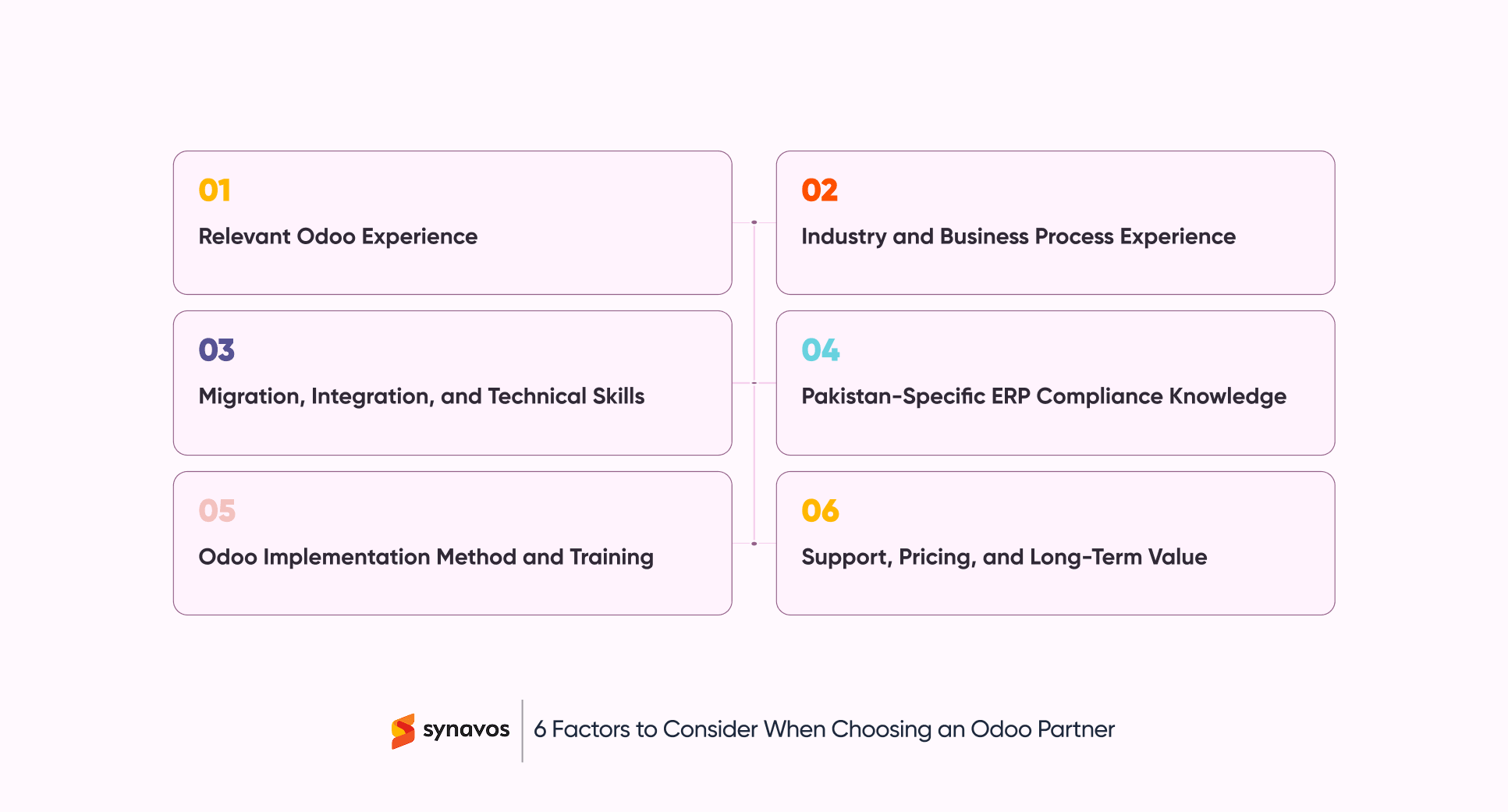
6 Checks to Make Before Choosing an Odoo Partner
The right Odoo partner should have relevant implementation experience, strong industry knowledge, reliable migration and integration skills, an understanding of Pakistan-specific requirements, a clear implementation method, and dependable post-go-live support.
When comparing Odoo implementation services in Pakistan, these six areas will tell you far more than a polished demo or sales presentation.
1. Check Relevant Odoo Experience
Check the partner’s official Odoo profile, customer references, certifications, and industries. Then ask for projects and case studies that resemble your own.
If you run manufacturing operations, you want a team that can talk comfortably about MRP, bills of materials, production planning, purchasing, stock, quality, and reporting.
A retailer should hear equally practical answers around POS, multi-location inventory, eCommerce, customer data, and accounting.
The point is not to find a partner that has simply “done Odoo before.” It is to find one that has dealt with the type of complexity your business has.
Version experience matters too. With Odoo 20 now available, the team should be able to explain whether moving to the latest version makes sense for your business rather than recommending it simply because it is new.
Evidence to Request: Two relevant case studies, the proposed team roles, and one client reference willing to discuss the experience.
2. Verify Industry and Business Process Experience
A good Odoo implementation starts with understanding how your business works today.
Ask questions such as: How does an order move through the company? Who approves a purchase? What happens when stock runs out? Where do employees leave the ERP and switch to spreadsheets, email, or WhatsApp?
This is where discovery and process mapping come in.
A sound discovery process should map the current workflow, identify pain points, design the future process, check standard Odoo fit, and document any gaps. This helps avoid paying to recreate inefficient workflows as custom software.
Evidence to Request: A sample process map, requirements or gap-analysis document, and a clear rule for deciding between configuration and customization.
3. Evaluate Data Migration, Integration, and Technical Skills
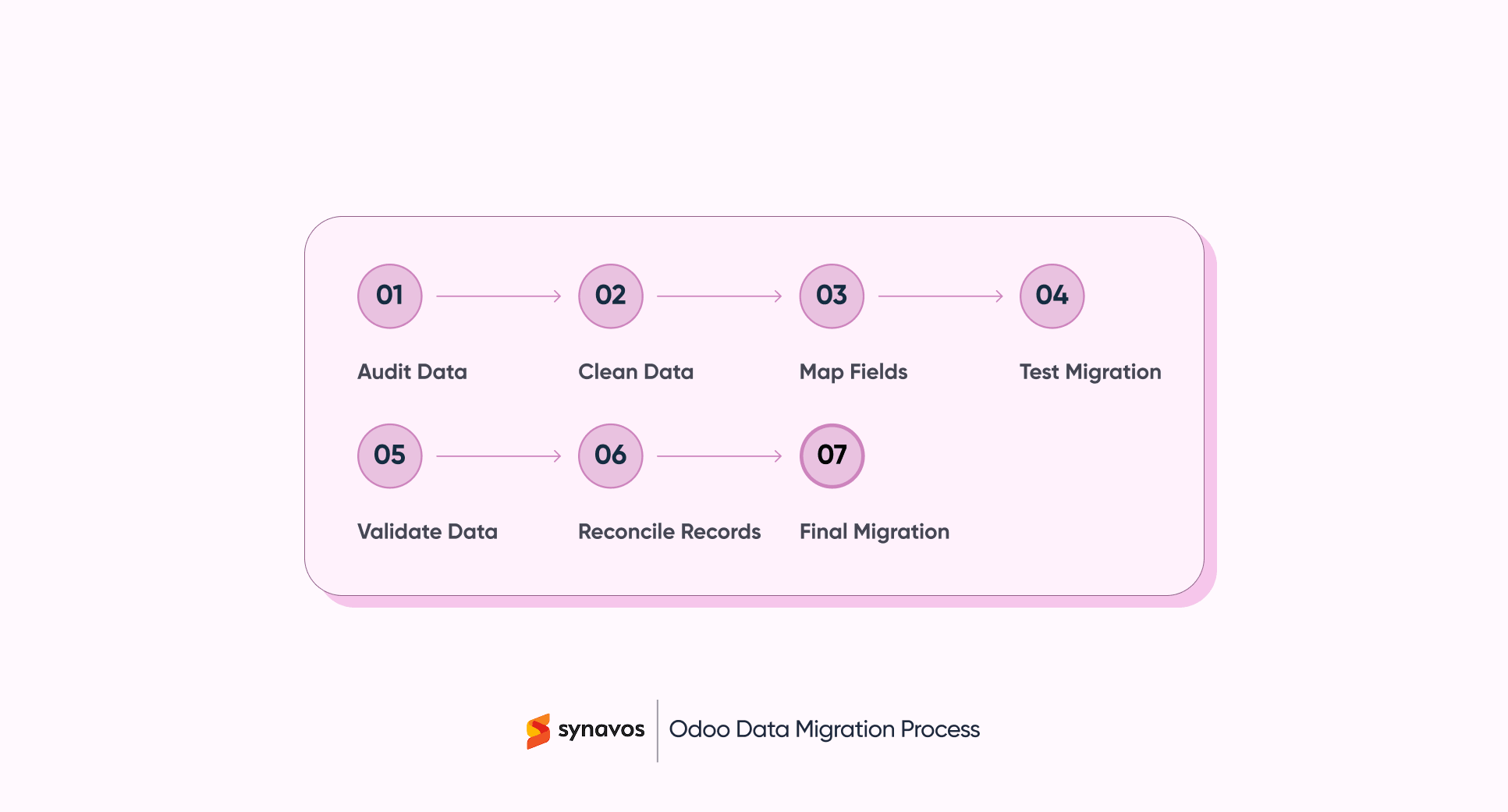
Business data rarely arrives ready to import. Customer lists may contain duplicates; products may use inconsistent codes; opening balances may not reconcile. Ask the partner to describe how it will audit, clean, map, test, validate, reconcile, and finally migrate your data.
Do not accept “the data will be migrated” as a sign-off plan. Ask which records will be reconciled, who will approve the results, and what happens when a trial migration exposes missing or mismatched information.
For integrations with Shopify, payment gateways, couriers, banking tools, or other ERPs, check how errors, duplicates, access rights, and monitoring will be handled. For custom modules, clarify documentation, licensing, maintenance, and any contractual rights to the code. Unnecessary customization can add cost long after go-live.
Evidence to Request: A sample reconciliation report, integration design, test cases, and written custom-code terms.
4. Check Pakistan-Specific ERP and Compliance Knowledge
A strong Odoo partner in Pakistan should understand the local requirements that may affect your ERP, including taxation, invoicing, payroll, reporting, withholding tax, and relevant provincial rules.
FBR electronic invoicing requirements are one example. If your business falls under the relevant requirements, your Odoo setup may need to work with systems approved under the FBR framework.
Your implementation partner should understand how Odoo fits into that process.
However, an Odoo company should not automatically be treated as an FBR-licensed integrator unless it holds that status. In some projects, the Odoo partner may prepare the ERP side while working with a licensed integrator.
The partner does not need to replace your finance or tax adviser. It does need to understand how local requirements affect the system it is building.
Evidence to Request: A relevant invoicing demo and a tax-scenario test plan, where applicable. Your finance or tax adviser should confirm which rules apply to your business.
5. Review Their Odoo Implementation Method and Training
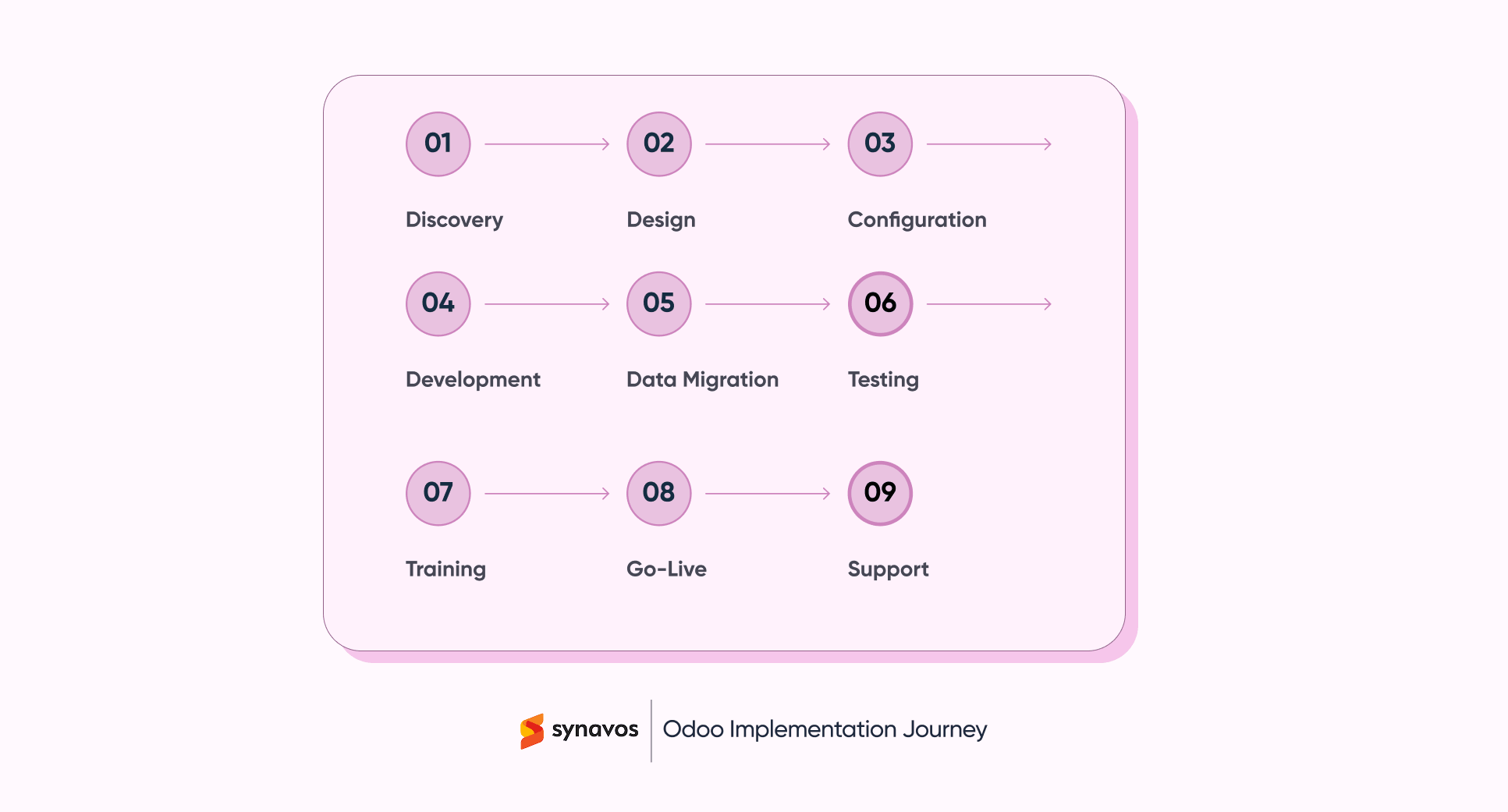
A sensible project plan normally includes discovery, design, configuration, needed development, migration, testing, user training, go-live, and support. The sequence is less important than accountability: who approves scope, handles changes, signs off on test cases, and makes the final go-live decision?
The exact method may differ, but ownership should always be clear. You should know who manages the project, who approves requirements, how scope changes are handled, who signs off on testing, and who makes the final go-live decision.
User Acceptance Testing, or UAT, is especially important because real users need to test real workflows. A sales order, for example, may need to move through inventory, delivery, invoicing, and reporting before you know whether the full process works.
Evidence to Request: The project roadmap, milestone owners, UAT scenarios, training plan, cutover checklist, and first-week support plan.
6. Compare Odoo Support, Pricing, and Long-Term Value
Go-live is not the finish line. Once people start using Odoo every day, new questions and changes will appear. So, ask about support before signing.
Check:
- Support hours
- Response times
- Hypercare after go-live
- Upgrade support
- Custom module maintenance
- Issue tracking
- Future improvements
Then compare price carefully. One partner may look more expensive because the quote includes discovery, migration, testing, training, and support. Another may look cheaper because those items are missing.
Odoo Implementation Cost in Pakistan
Odoo pricing in Pakistan depends on licensing, implementation scope, and business requirements. In 2026, Odoo Standard starts at $24.90 (approximately PKR 6,900) per user/month, while the Custom plan starts at $49 (approximately PKR 13,600) per user/month, based on first-year promotional pricing billed annually.
One-time implementation costs in Pakistan may range from PKR 300,000–700,000 ($1,100–2,500) for small businesses, PKR 700,000–2 million ($2,500–7,200) for mid-sized projects, and PKR 2–5 million+ ($7,200–18,000+) for larger deployments. These are indicative market estimates, not fixed Synavos quotes. Actual costs vary with customization, integrations, and data migration.
For more details, read our Odoo Implementation Cost: A Complete 2026 Breakdown.
10 Questions to Ask an Odoo Partner Before Signing
Before choosing an Odoo partner, ask:
- Can you show projects similar to ours?
- Who will actually work on our implementation?
- How do you map business processes?
- How do you decide when customization is needed?
- How do you handle data migration?
- How do you test integrations?
- Who owns custom code and documentation?
- How do you control changes in scope?
- What support do we receive after go-live?
- How will the system handle future upgrades?
Specific answers are a good sign. “We follow best practices” is not a specific answer. A partner that can clearly explain its discovery, migration, testing, UAT, and support process gives you a much better idea of how your project will actually be managed.
Red Flags to Watch When Choosing an Odoo Partner
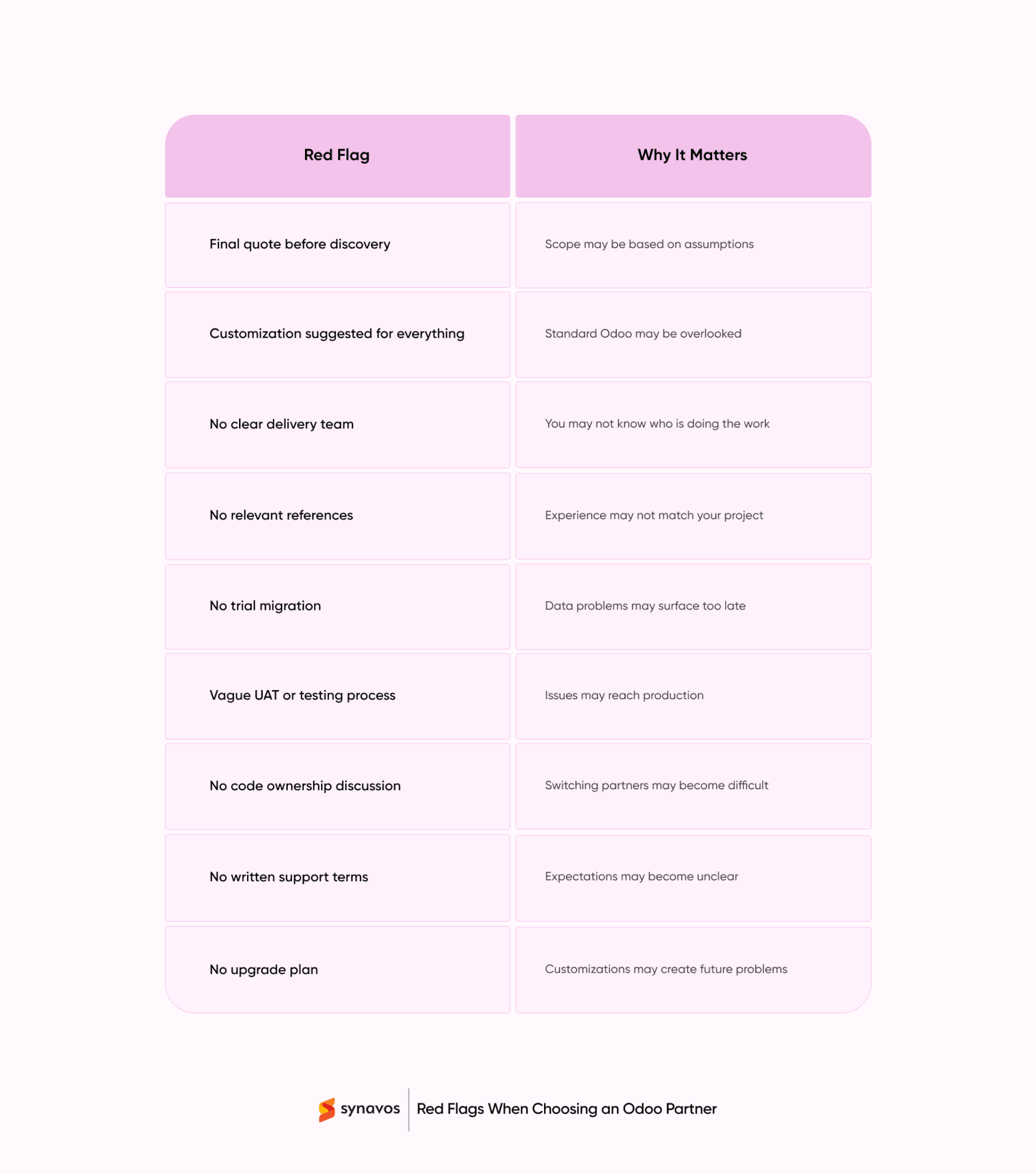
Before choosing an Odoo implementation partner, look beyond pricing and promises. Certain red flags can indicate potential delivery, cost, and long-term maintenance challenges. Here are eight warning signs to watch for before making your decision.
Final Thoughts: Choosing the Right Odoo Partner
The best Odoo partner in Pakistan is not automatically the company with the highest partner level, the largest team, or the lowest quote. It is the partner that understands your business, knows how to manage the project, and can build an Odoo setup that people will actually use.
So, check experience. Ask about methodology. Review references. Challenge unnecessary customization. Understand support. And compare long-term value, not just the first invoice.
Why Choose Synavos as Your Odoo Partner in Pakistan?
Choosing the best Odoo partner comes down to more than technical expertise. You need a team that understands your business, knows how to manage the implementation from start to finish, and can continue supporting the system as your needs change.
As an official Odoo Silver Partner, Synavos works with businesses across Pakistan and the GCC, including Saudi Arabia. We help companies plan, implement, customize, integrate, and support Odoo around their actual operational requirements.
So if you are planning a new Odoo implementation, moving from another ERP, or reviewing an existing setup, talk to our Odoo experts to find the right approach for your business.