
When an Odoo implementation goes wrong, the problem is rarely just the software. It is often who you hired, what they were responsible for, and what they could actually deliver. That is why choosing between an Odoo consultant and an Odoo partner is not as simple as comparing cost, team size, or credentials.
The labels can look reassuring. The delivery reality may be very different.
Therefore, before you sign a proposal, commit budget, or trust someone with your ERP rollout, you need to know what you are actually buying.
Read on to understand where Odoo consultants and Odoo partners really differ.
What Is an Odoo Consultant?
An Odoo consultant helps businesses translate operational requirements into a workable Odoo setup. Depending on their expertise, consultants generally fall into two categories: functional and technical.
Functional vs Technical Odoo Consultant
Although both work toward the same goal, their responsibilities differ.
1. Functional Odoo Consultant
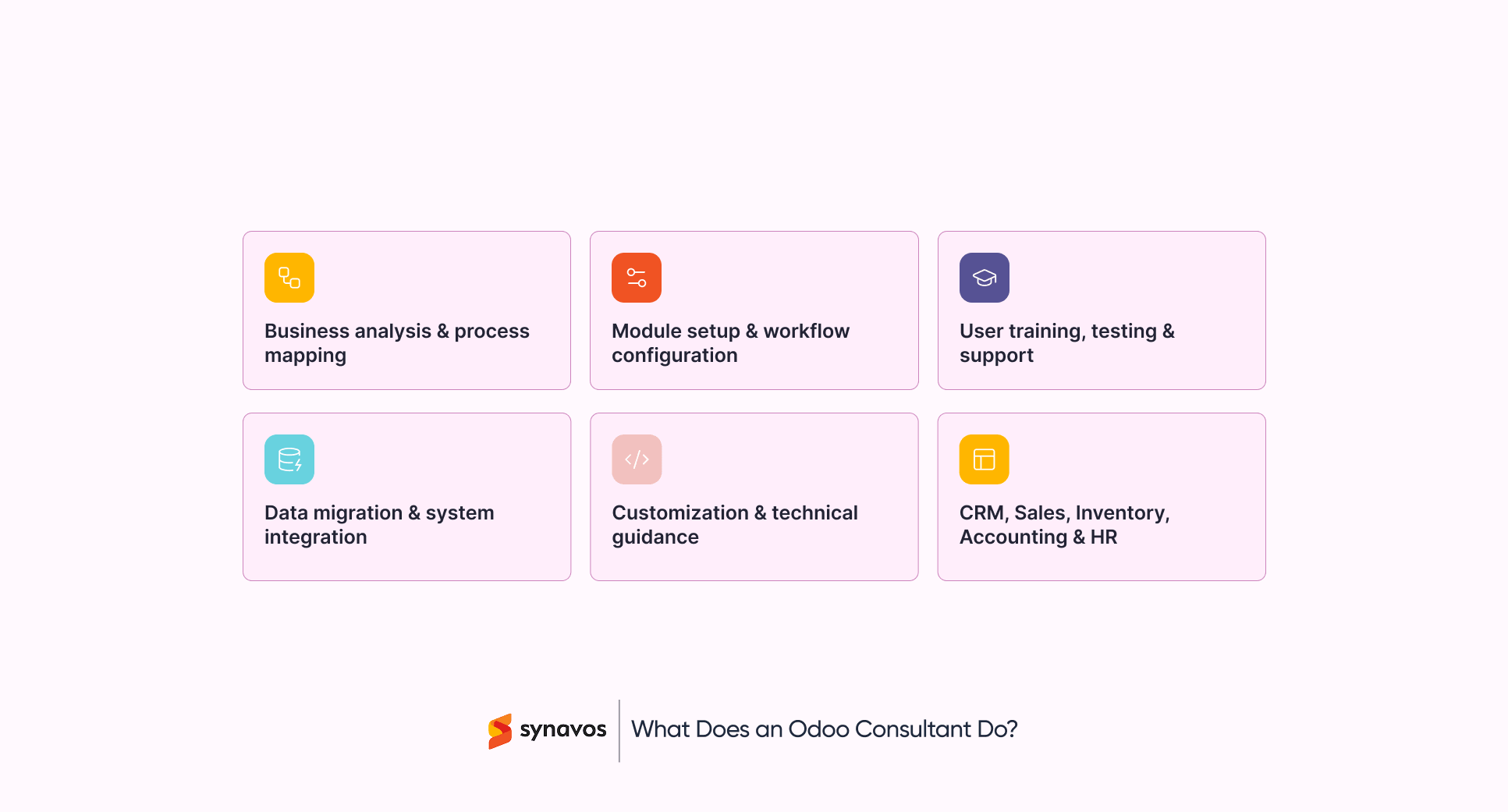
A functional consultant focuses on business processes and how Odoo can support them. Their responsibilities typically include:
- Gathering business requirements and mapping existing processes.
- Configuring Odoo modules such as CRM, Sales, Inventory, Accounting, Manufacturing, and HR.
- Designing workflows and aligning system functionality with business needs.
- Conducting user training, testing, and implementation support.
2. Technical Odoo Consultant
A technical consultant focuses on the development, customization, and technical aspects of Odoo. Their responsibilities typically include:
- Writing custom code and developing Odoo modules.
- Customizing existing functionalities to meet specific business requirements.
- Managing databases and handling technical configurations.
- Developing APIs and integrating Odoo with third-party applications.
- Troubleshooting technical issues and optimizing system performance.
What Is an Official Odoo Partner?
An official Odoo partner is a company that works within Odoo’s official partner ecosystem to sell, implement, customize, and support Odoo solutions for businesses.
Unlike an individual consultant, a partner typically delivers projects through a broader team of functional consultants, developers, project managers, and support specialists.
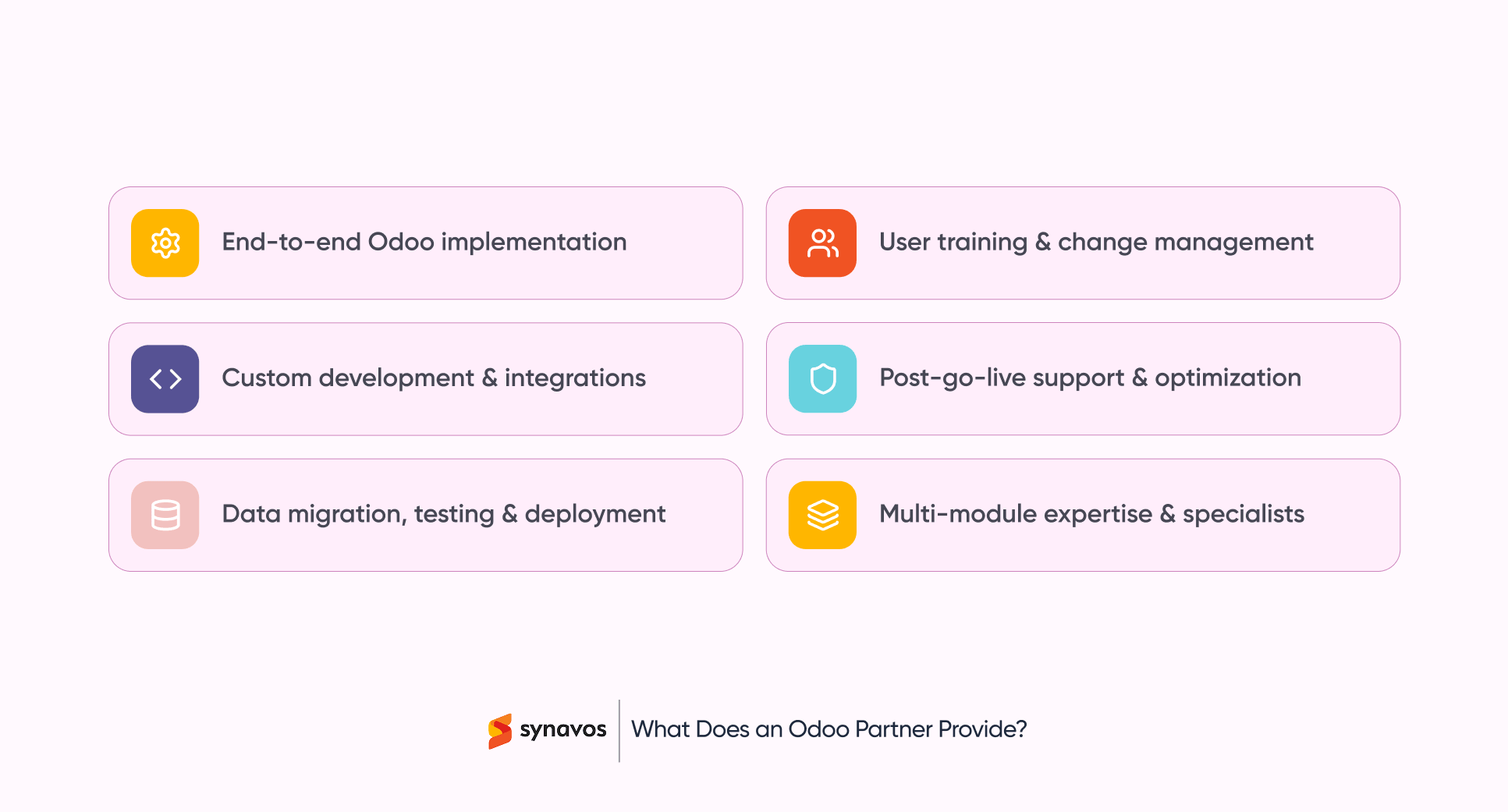
What Does an Odoo Partner Typically Provide?
- End-to-end Odoo implementation and configuration
- Custom development and third-party integrations
- Data migration, testing, and deployment
- User training and change management
- Post-go-live support and ongoing optimization
- Access to specialists across multiple Odoo modules
If you're also comparing a full implementation team with an individual technical resource, read our guide on Odoo Implementation Company vs. Odoo Developer: Who to Hire? to understand the differences in responsibilities, project scope, and costs.
Odoo Consultant vs. Odoo Partner at a Glance
The easiest way to understand the difference is to look beyond the title and compare how each engagement is set up.
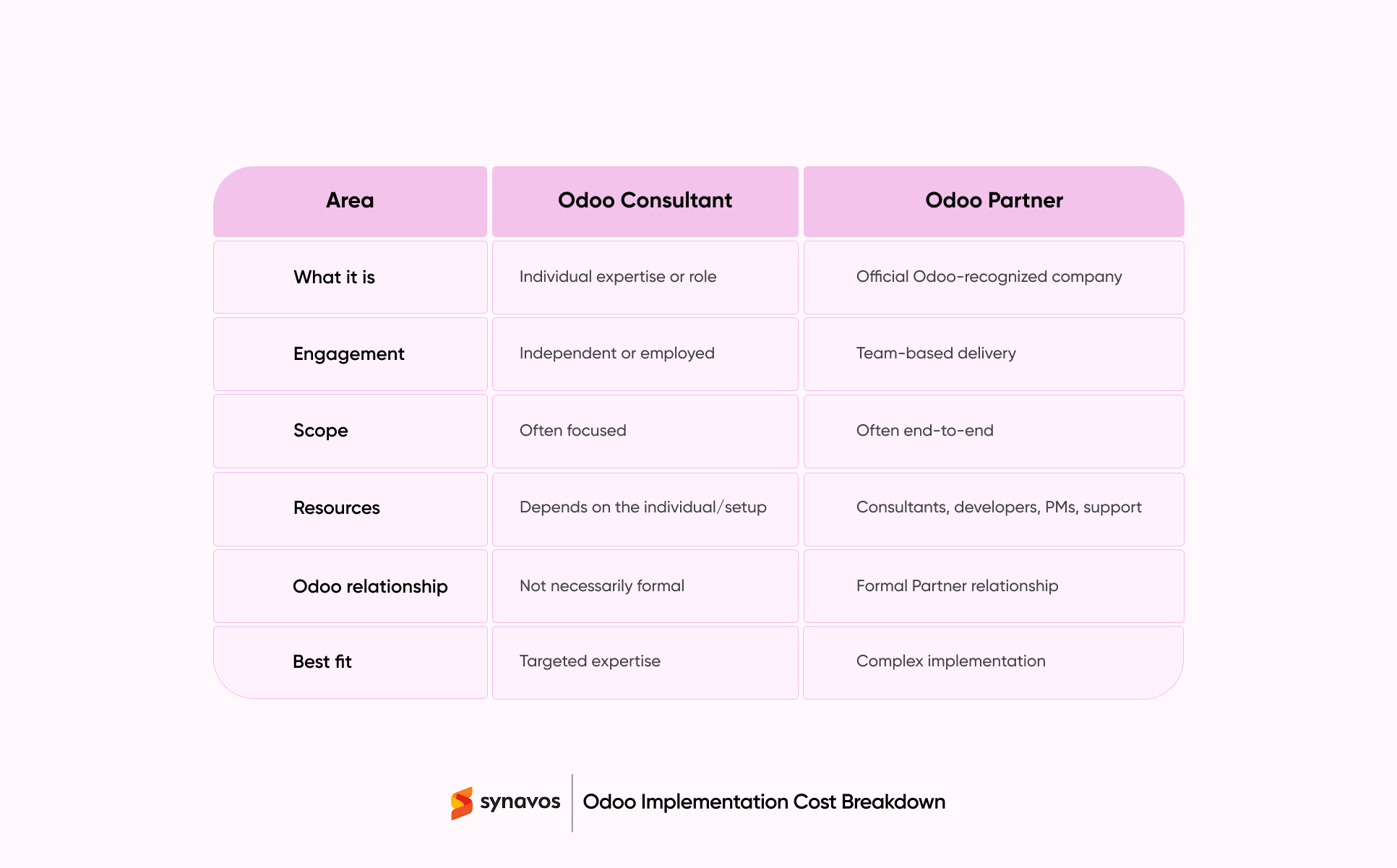
The comparison above highlights the structural differences between an Odoo consultant and an Odoo Partner. However, their engagement models and the types of projects they handle also differ.
Engagement and Pricing Model
- Odoo Consultant: Typically hired on an hourly or task-based arrangement for specific requirements, short-term assignments, or targeted improvements.
- Odoo Partner: Generally engaged through structured implementation projects and longer-term contracts covering deployment, maintenance, and ongoing support.
Where an Odoo Consultant Can Be the Better Fit
An independent Odoo consultant can be the right choice when the problem is narrow, and your business already has enough internal ownership. In fact, an Odoo consultant only makes sense when:
- The scope is clearly defined
- You need a second opinion on an existing setup
- There is little migration or integration work
- Your internal team can manage the wider project
- You need specialist knowledge for a limited period.
There is no benefit in hiring a full project team for a task that one experienced consultant can handle well. Corporate procurement does not need to become a hobby.
Where an Odoo Partner Becomes More Useful
An Odoo implementation partner becomes more useful when your business needs a coordinated approach involving multiple departments, technical resources, and ongoing support. An Odoo Partner is generally a better fit when:
- You are planning a complete ERP implementation across multiple departments.
- The project involves significant data migration, custom development, or third-party integrations.
- Multiple business processes and teams need to work together.
- You need dedicated project management, UAT, user training, and deployment support.
- You require ongoing maintenance, technical support, and long-term system optimization.
When several workstreams depend on each other, a dedicated implementation team can provide the coordination, resources, and continuity needed to manage the project effectively.
Five Questions to Ask Before Choosing
Instead of asking which title sounds stronger, ask what the project actually needs.
1. Is the Problem Narrow or Business-Wide?
Improving one workflow is very different from implementing Odoo across Finance, Sales, Inventory, Purchasing, and Manufacturing.
2. Who Will Manage the Project Internally?
If you already have strong ERP leadership in-house, a consultant-led model can work well. Without that internal ownership, more external project structure may be useful.
3. How Many Skills Will the Project Need?
Functional consulting, development, migration, integrations, testing, training, and support may require different people. The wider the skill mix, the harder it becomes to depend on one resource.
4. How Much Risk Sits in the System?
A CRM used by one team carries different risk from an ERP running finance, inventory, procurement, or manufacturing. As business impact increases, continuity and accountability matter more.
5. What Happens After Go-Live?
Someone still needs to own support, upgrades, documentation, integrations, and custom code once the implementation is finished.
Evaluate Odoo Expertise, Not Just Partner Status
An official Odoo Partner is not automatically more experienced than an independent Odoo consultant. What matters is the expertise of the people handling your implementation.
Before hiring, evaluate these key factors:
- Certifications: Check the team's Odoo qualifications and technical skills.
- Industry Experience: Review similar Odoo implementation projects.
- Client References: Ask for case studies and customer feedback.
- Technical Expertise: Assess data migration, integration, and customization experience.
- Post-Go-Live Support: Confirm ongoing support and maintenance availability.
Use the Synavos Odoo Implementation Partner Checklist to evaluate vendors and compare proposals confidently.
Wrapping Up
There's no one-size-fits-all answer to the Odoo consultant vs. Odoo partner debate.
Need help fixing a specific issue or improving an existing workflow? An experienced Odoo consultant might be enough.
Planning a complete Odoo implementation with multiple departments, integrations, and ongoing support? An Odoo implementation partner with a dedicated team may be a better fit.
How Can Synavos Help?
Every business has different processes, challenges, and expectations. So why should every Odoo implementation follow the same approach? At Synavos, we start by understanding what your business needs, then bring in the right people to deliver it.
As an official Odoo Silver Partner with 50+ successful Odoo implementations across industries such as manufacturing, retail, hospitality, finance, construction, and healthcare, Synavos brings proven industry experience to every project.
From Odoo consulting and customization to seamless integration, migration, and post-go-live support, we help businesses across Pakistan and the Middle East turn ERP technology into measurable business value.
Talk to our Odoo experts and find out what the right implementation approach looks like for your business.