Saudi businesses are relying on technology more than ever, from cloud platforms and business applications to connected infrastructure and digital services. As these environments become more complex, managing everything in-house can put pressure on internal teams, increase costs, and make it harder to keep systems secure and reliable.
That is why more businesses are turning to managed IT services in Saudi Arabia. An experienced managed service provider (MSP) can handle ongoing IT support, monitoring, infrastructure, and security while giving businesses access to specialized expertise without the cost of building a large internal IT team.
The Shift to Managed IT Services in Saudi Arabia
Managing IT internally can work well when the environment is small and relatively straightforward. But things change as a company grows. More employees mean more devices and user accounts, while new applications, cloud platforms, locations, and security requirements add more to the workload.
At some point, an internal team may find itself spending most of its time keeping things running rather than improving the technology. This is where an MSP can help. Businesses can bring in the expertise they need without having to hire a separate specialist for every part of their IT environment.
7 Reasons Saudi Businesses Are Choosing Managed IT Services
The move toward managed IT services is not simply about outsourcing IT support. For many Saudi businesses, it is about having a more practical way to manage growing technology requirements while keeping costs, security, and reliability under control.
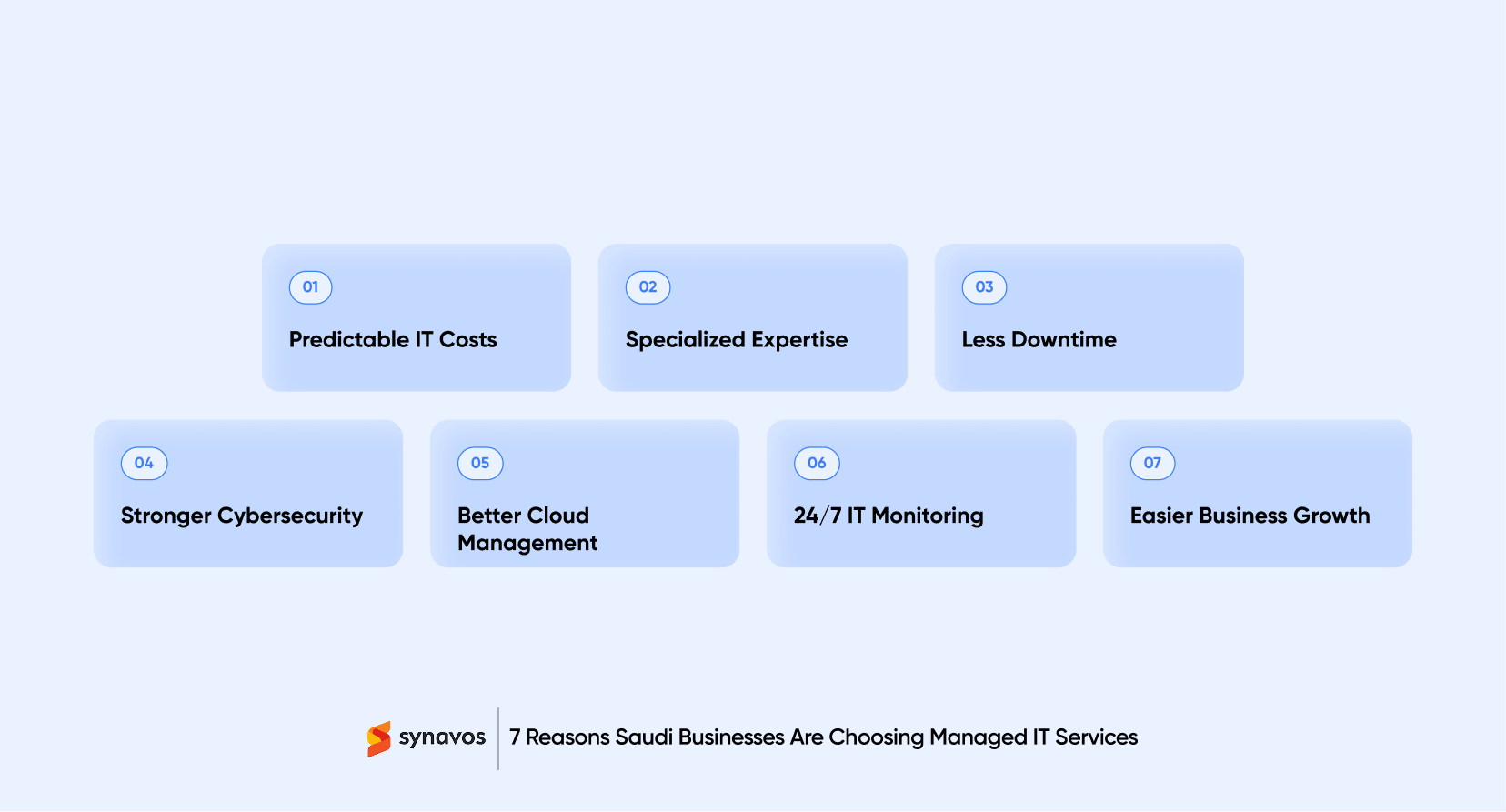
1. Lower and More Predictable IT Costs
As a business grows, its IT needs rarely stay simple. What starts with basic technical support can eventually require expertise in cybersecurity, cloud platforms, networking, infrastructure, and more. Hiring separate specialists for all these areas can quickly become expensive.
With managed IT services, businesses can access a broader range of expertise through one provider and a predictable monthly cost. This makes IT spending easier to plan and avoids the cost of building a large internal team just to cover every possible requirement.
2. Access to Specialized IT Expertise
Finding people who are experienced in every area of modern IT is difficult, particularly for businesses that do not have a large technology department.
An MSP brings together professionals with different areas of expertise. Whether a business needs help with cloud infrastructure, networking, cybersecurity, or system management, it can draw on the right expertise when needed rather than relying on one or two people to handle everything.
3. Faster IT Support and Less Downtime
A small IT problem can quickly become a business problem. An employee unable to access an application loses time, while a network or server issue can affect an entire team.
Managed IT providers combine day-to-day support with proactive maintenance and monitoring. This means issues can be identified and dealt with sooner, while routine maintenance helps prevent some problems from happening in the first place. The result is less disruption and more time for employees to focus on their actual work.
4. Stronger Cybersecurity
Keeping an IT environment secure is an ongoing job. Software needs to be patched, devices need protection, vulnerabilities need to be addressed, and unusual activity needs to be investigated.
Managed IT services can bring these responsibilities together through endpoint protection, patch management, vulnerability assessments, email security, access controls, monitoring, and incident response. For Saudi businesses handling sensitive information or operating in regulated industries, having these security measures managed consistently can make a significant difference.
5. Better Cloud and IT Infrastructure Management
Cloud services have made it easier for businesses to access the technology they need, but they have also added another layer to IT management. Microsoft 365, Azure, AWS, hybrid environments, servers, networks, and business applications all need to work together reliably.
An MSP can take care of this wider environment rather than treating each system as a separate responsibility. That means businesses have one team looking at the bigger picture, keeping infrastructure maintained, resolving issues, and identifying areas that need attention.
6. 24/7 IT Monitoring
Not every IT problem happens at 9 in the morning. A server can fail overnight, storage can fill up, or unusual activity can appear when no one from the internal team is watching.
24/7 monitoring gives businesses another layer of protection. Critical systems are watched continuously, so potential issues can be spotted and investigated before they turn into larger problems. For businesses that depend on systems being available around the clock, this can be particularly valuable.
7. Easier Business Growth
Growth brings new IT requirements with it. More employees mean more devices and accounts. New offices need networks and secure connectivity, while new applications add another layer to the IT environment.
An MSP can help manage these changes as they happen. Instead of rebuilding the IT function every time the business expands, companies can increase the level of support they receive as their requirements change.
Managed IT Services and Saudi Cybersecurity Requirements
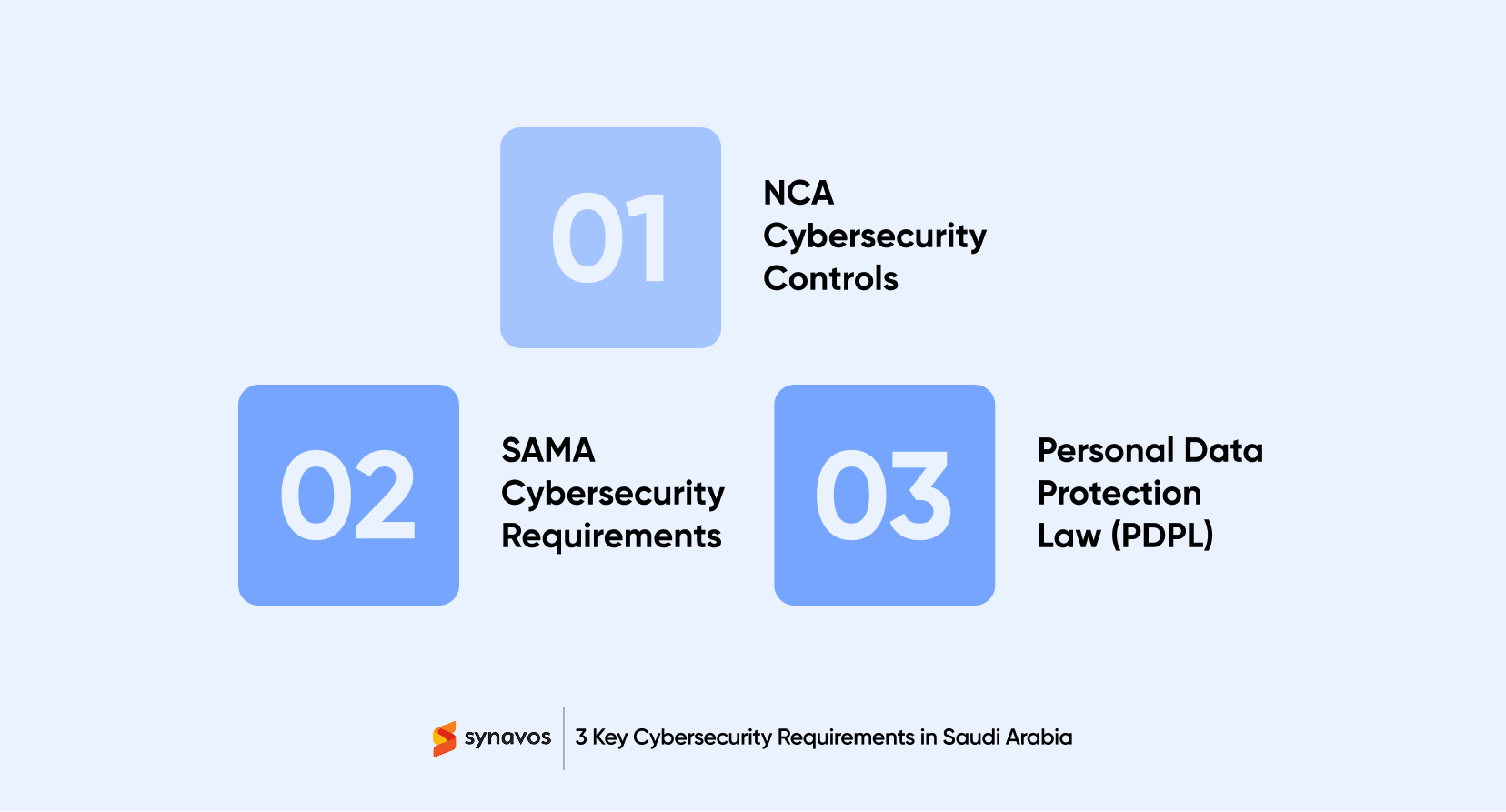
Cybersecurity is a growing concern for businesses operating in Saudi Arabia, particularly those handling sensitive data or working in regulated industries. Depending on the organization and sector, businesses may need to consider requirements such as the National Cybersecurity Authority (NCA) controls, SAMA cybersecurity requirements, and the Personal Data Protection Law (PDPL).
When evaluating a Managed Services Provider (MSP), businesses should ask how it manages access, security monitoring, patching, vulnerabilities, backups, documentation, and incident response. It is also worth understanding how the provider’s processes can support the organization’s own regulatory responsibilities.
Working with an MSP does not automatically make a business compliant. The provider should instead be able to clearly explain the security controls and services it offers and how they fit into the organization’s specific requirements.
Which Saudi Businesses Can Benefit From Managed IT Services?
Managed IT services can benefit businesses across Saudi Arabia, especially those that rely heavily on technology, handle sensitive data, or operate across multiple locations.
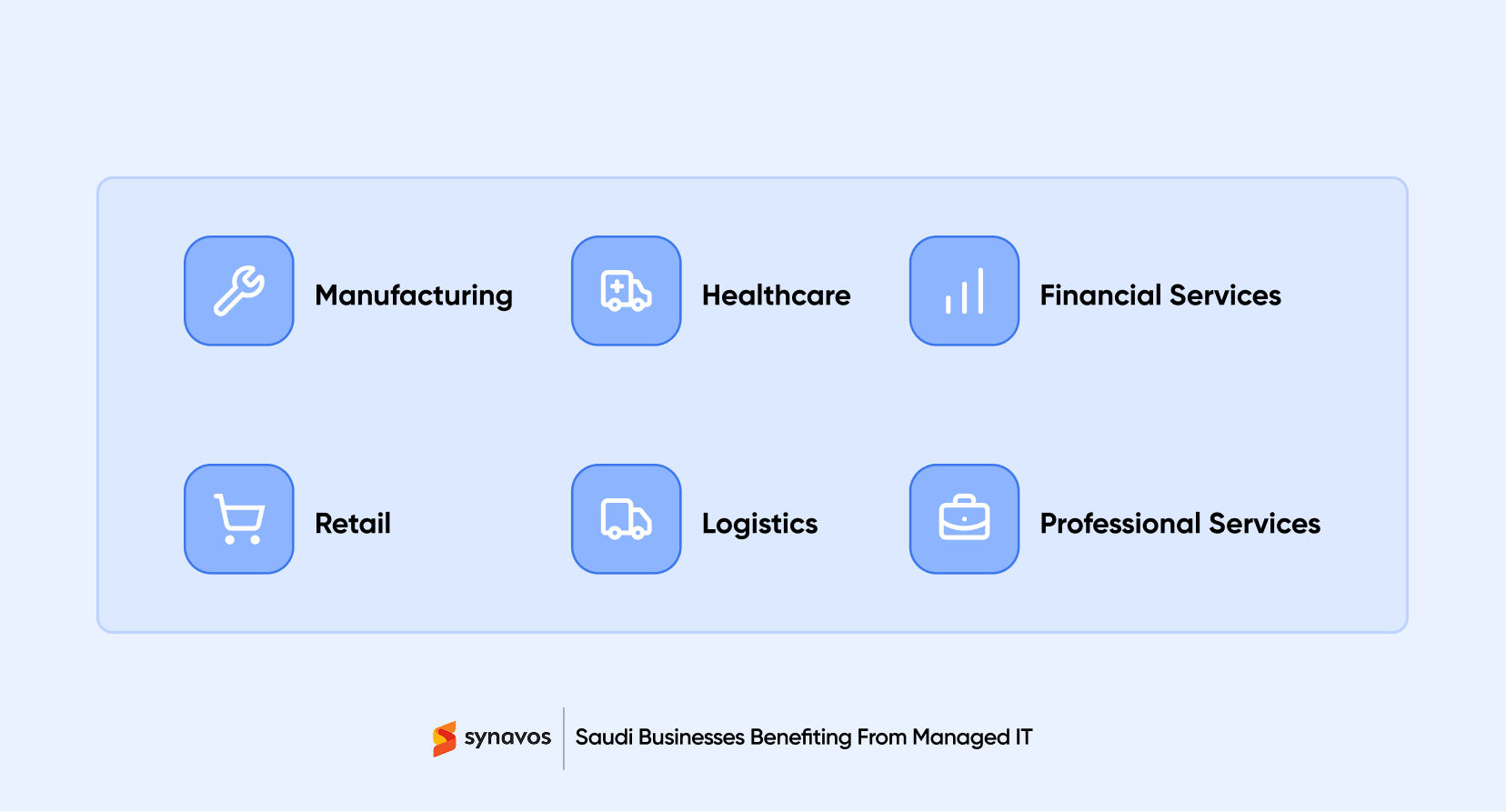
Manufacturing
Saudi Arabia’s manufacturing sector depends on production systems, enterprise applications, networks, and connected equipment to keep facilities running. An MSP can help maintain this infrastructure, monitor critical systems, address security issues, and reduce technology-related disruptions.
Healthcare
Saudi healthcare organizations depend on reliable IT systems while handling sensitive patient and medical information. Managed IT services can support infrastructure, cybersecurity, data backup, secure access, and day-to-day technical support, helping hospitals, clinics, and healthcare providers keep essential systems available.
Financial Services
Saudi banks, fintech companies, financing companies, and other financial organizations operate in a highly security-conscious environment. Managed IT services can help maintain secure infrastructure through continuous monitoring, cybersecurity, backup, patch management, and technical support while supporting the technology needs of growing financial businesses.
Retail
Retail businesses across Saudi Arabia increasingly rely on point-of-sale systems, cloud applications, digital platforms, and connected branches. Managed IT services can help keep these systems running reliably, maintain secure connectivity between locations, and resolve technical issues before they affect customers or employees.
Logistics & Transportation
Saudi Arabia’s growing logistics and transportation sector relies on technology for fleet management, tracking, warehouse operations, communications, and coordination. Managed IT services can help businesses keep these systems connected, secure, and available across offices, warehouses, distribution centers, and other operating locations.
Professional Services
Law firms, consulting companies, accounting firms, and other professional businesses in Saudi Arabia rely heavily on cloud applications, communication platforms, and secure access to client information. An MSP can manage these systems, strengthen security, and provide ongoing IT support without requiring businesses to build a large internal IT team.
Choosing the Right Managed IT Services Provider
The benefits of managed IT services depend heavily on the provider you choose. Look for an MSP with the right technical expertise, security practices, support capabilities, and experience with the Saudi business environment.
Final Thoughts
As Saudi businesses become more dependent on technology, managing IT effectively is becoming a business priority rather than just an IT responsibility. Managed IT services offer a practical way to keep systems secure and reliable while giving businesses access to the expertise they need as their technology requirements grow.
The key is finding an MSP that understands your business and can grow with it, not simply a provider that responds when something goes wrong.
Synavos – Your Trusted Managed IT Partner in Saudi Arabia
Choosing an MSP in Saudi Arabia means finding a provider that understands your business and can take responsibility for the technology you rely on every day. Based in Riyadh, Saudi Arabia, Synavos provides managed IT services covering support, infrastructure, cloud, cybersecurity, monitoring, and backup.
With ISO 9001 and ISO 27001 certifications, fixed monthly pricing, and 24/7 IT monitoring, we give Saudi businesses the expertise and ongoing support they need to manage IT today and prepare for what’s next.
Ready to take IT off your plate? Get in touch with Synavos to discuss your managed IT needs.