Many businesses implement Odoo with clear goals in mind, for instance, streamlined operations, accurate reporting, and better control over decision-making. Yet, as time passes, those goals often feel harder to reach. Reports stop aligning, manual work increases, and teams begin relying on spreadsheets alongside the ERP.
According to Gartner, more than 70% of ERP initiatives fail to fully meet their original business objectives by the mid-2020s, and up to 25% fail catastrophically. These failures are rarely caused by poor software. As companies grow, evolve, or restructure, their Odoo ERP setup often remains frozen in time. What once worked becomes restrictive. What once felt efficient becomes a source of friction, and this is where Odoo re-implementation becomes relevant.

Explore this guide to learn what Odoo re-implementation really means, when it becomes necessary, and how to approach it step by step without repeating past mistakes.
What is Odoo Re-Implementation?
Odoo re-implementation is the structured process of redesigning and reconfiguring an existing Odoo ERP system to align it with current business processes, data requirements, and operational goals. Unlike quick fixes or isolated improvements, re-implementation looks at the ERP holistically. It examines how workflows are defined, how data is structured, how reports are generated, and how users interact with the system on a daily basis.
However, it typically includes:
- Reviewing and redesigning business processes
- Cleaning and restructuring system configuration
- Correcting data foundations and reporting logic
- Improving user adoption and system ownership
Why Odoo Implementation Fails Over Time
Most Odoo ERP implementations fail slowly, not suddenly. During the initial deployment of Odoo modules, businesses often make certain compromises. Timelines are tight. Processes are simplified to meet go-live dates. Customizations are added to handle edge cases. Training is limited to a small group of users. At first, these decisions seem harmless.
However, as the business grows, these shortcuts begin to surface. New products are introduced, as well as new legal entities or warehouses are added. Moreover, due to an increase in reporting requirements and a change of teams, what once worked becomes restrictive.
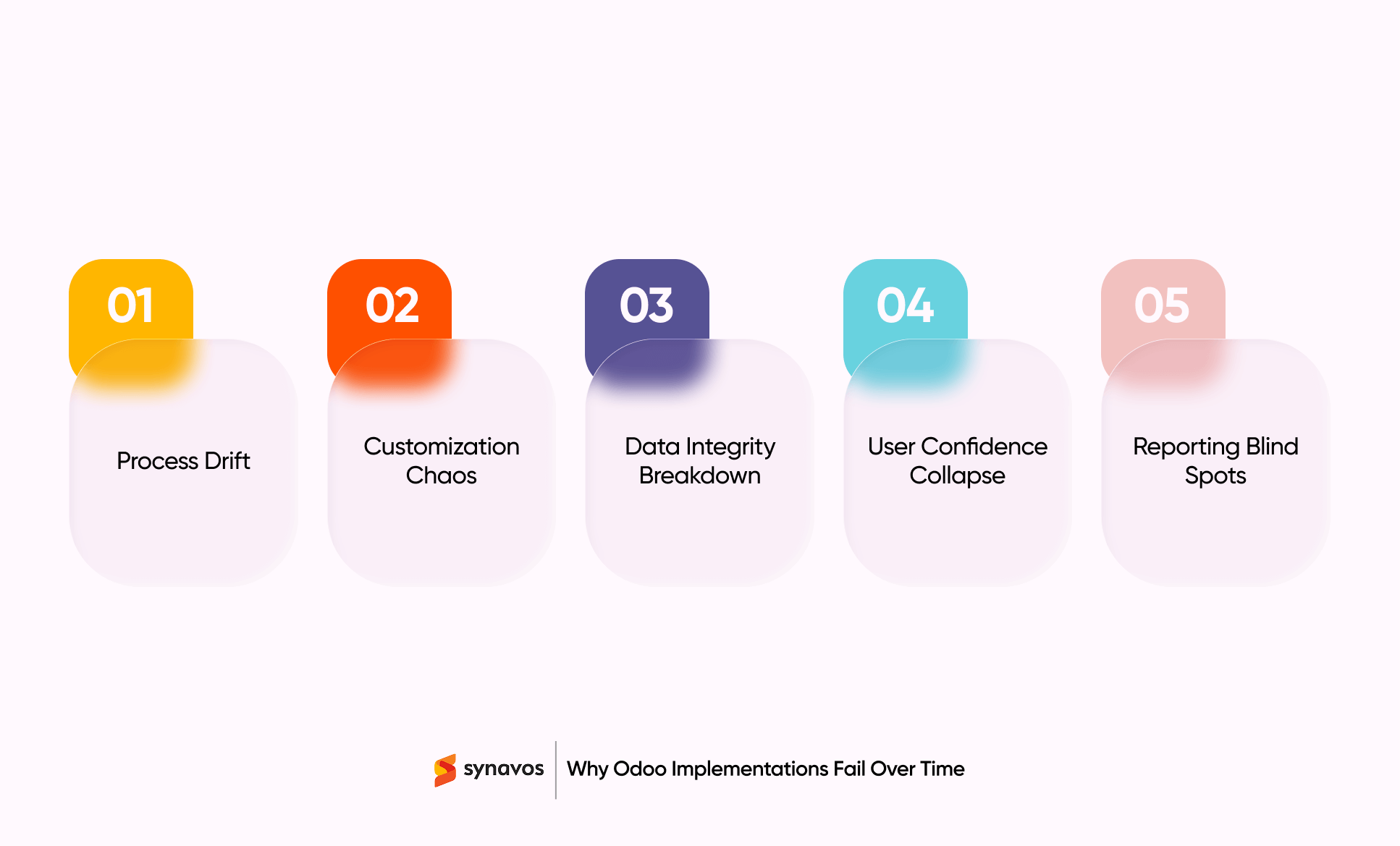
Nevertheless, the most common causes of Odoo ERP implementation failure are as follows:
- Processes in the system no longer match real operations
- Over-customization replaces standard functionality
- Inconsistent master data and unclear ownership
- Reporting logic that no one fully trusts
- Low user adoption and reliance on spreadsheets
If your Odoo once worked but now feels broken, this article Why Odoo Implementations Fail Over Time explains why and what to do next.
Odoo Re-Implementation vs Upgrade vs Customization
These three approaches can be confusing, but they solve very different problems.
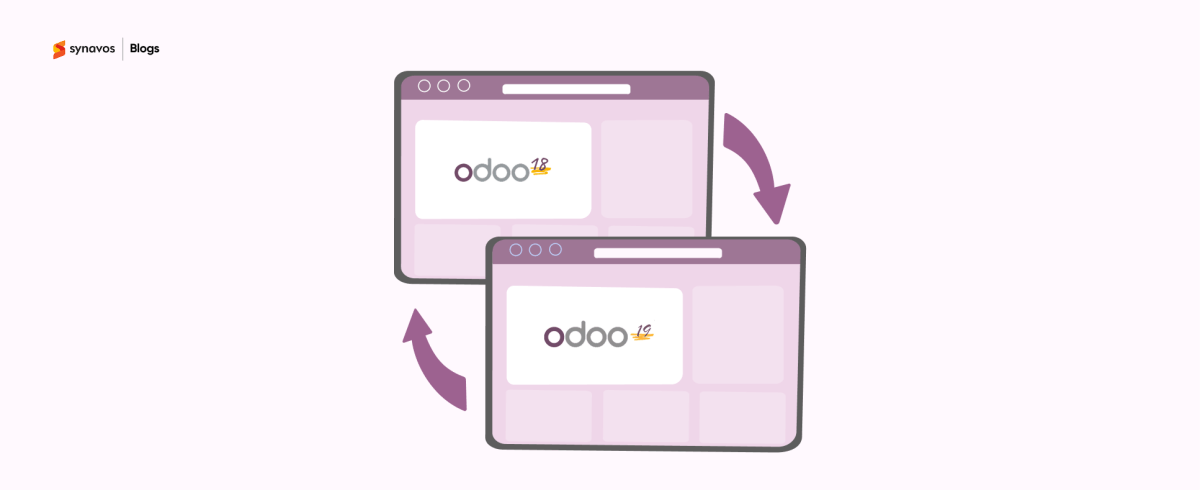
An Odoo upgrade moves the system to a newer version. It brings performance improvements and new features, but does not fix broken workflows, poor configuration, or unreliable data.
In contrast, customization changes how Odoo behaves. In some cases, it is necessary. In many others, it replaces standard functionality, increases maintenance effort, and creates long-term technical debt.
On the other hand, Odoo re-implementation focuses on fundamentals. It realigns processes, cleans configuration, restructures data, and restores reporting integrity. An upgrade or limited customization may happen during re-implementation, but they are supporting actions.
Key Signs Your Business Needs Odoo Re-Implementation
Businesses usually recognize the need for re-implementation through operational symptoms, such as:
- Different departments report different numbers
- Inventory balances that require manual correction
- Accounting closes that depend on spreadsheets
- CRM modules that are rarely used by sales teams
- Payroll or HR processes managed outside Odoo
- Frequent requests for custom development
When these issues persist, re-implementation becomes a practical solution rather than an optional improvement.
To understand when your Odoo setup requires immediate optimization or corrective action, explore our blog 7 Signs Your Odoo Implementation Needs Immediate Attention.
Who Should Consider Odoo Re-Implementation?
Odoo re-implementation is particularly relevant if:
- Your business has grown in size, locations, or complexity
- You operate across multiple companies or warehouses
- You rely on manufacturing, distribution, or project-based workflows
- You are running Odoo v14–v18 and struggling with scale
If growth feels harder than it should, your ERP structure may be part of the problem.
Step-by-Step Odoo Re-Implementation Process
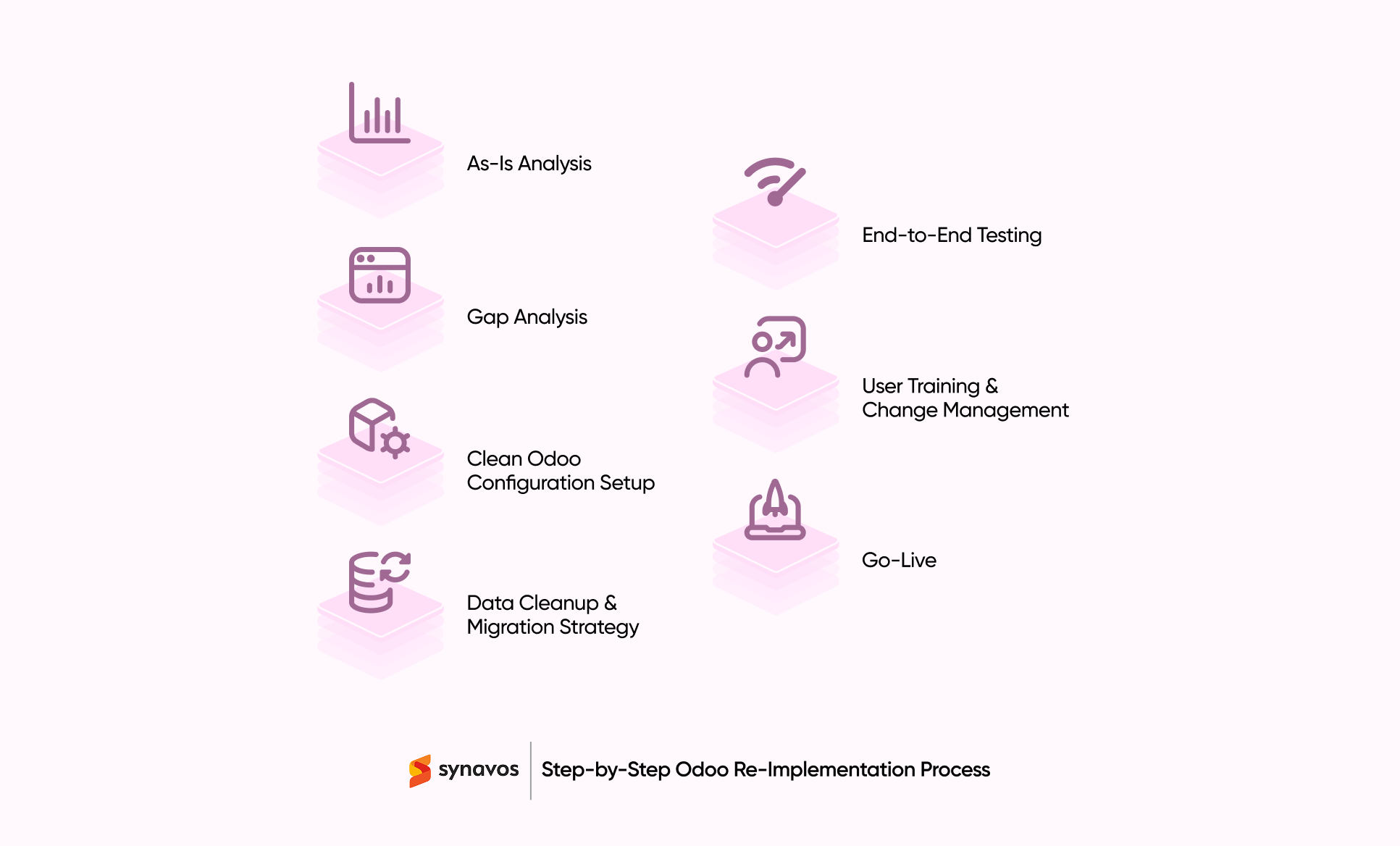
1. As-Is Analysis (Current System Assessment)
Re-implementation begins with understanding reality. This phase documents how the business actually operates today, not how processes were designed on paper. Sales flows, purchasing cycles, inventory handling, manufacturing steps, accounting practices, and HR processes are all reviewed as they exist now.
This analysis often explains why users created workarounds and where the system fails to support daily operations. Without this step, redesign efforts rely on assumptions instead of facts.
2. Gap Analysis & Business Process Redesign
Once the current state is clear, gaps between business needs and system behavior become visible. These gaps may include missing controls, redundant steps, manual interventions, or misused modules. Processes are redesigned to reduce complexity, improve consistency, and use standard Odoo capabilities wherever possible.
The focus is not automation for its own sake, but alignment and clarity.
3. Clean Odoo Configuration Setup
Re-implementation avoids stacking fixes on top of old problems. Configuration is reset cleanly to support redesigned processes.
Key areas include:
- Chart of accounts and financial structure
- Product, BOM, and inventory configuration
- Tax rules and valuation methods
- User roles, permissions, and approval flows
4. Data Cleanup and Migration Strategy
Data quality is one of the strongest predictors of ERP success. Before migration, existing data is reviewed carefully. Duplicate records are removed. Master data is standardized. Opening balances are verified. Historical data is evaluated for relevance.
Only clean and meaningful data is migrated into the re-implemented system. Everything else is archived. However, this prevents old issues from being carried forward.
5. End-to-End Testing with Real Business Scenarios
Testing is performed using real operational scenarios rather than theoretical cases.
Orders are processed from creation to payment. Purchases flow through inventory and accounting. Manufacturing orders are completed and costed. Payroll entries are posted to finance.
This approach validates system behavior, data accuracy, and reporting logic, reducing risk before go-live.
6. User Training & Change Management
A well-designed system still fails if users do not trust or understand it. That’s why user training focuses on roles and responsibilities rather than buttons and screens.
In fact, users learn how their actions affect data quality and reporting. Clear ownership improves accountability and adoption, reducing resistance to change.
7. Go-Live and Post-Implementation Stabilization
Go-live is not the end of re-implementation. The stabilization phase ensures transactions remain accurate, performance is stable, and users follow the designed processes.
Issues are addressed quickly before they become habits. This phase is critical for restoring long-term trust in the system.
Benefits of Odoo Re-Implementation for Businesses
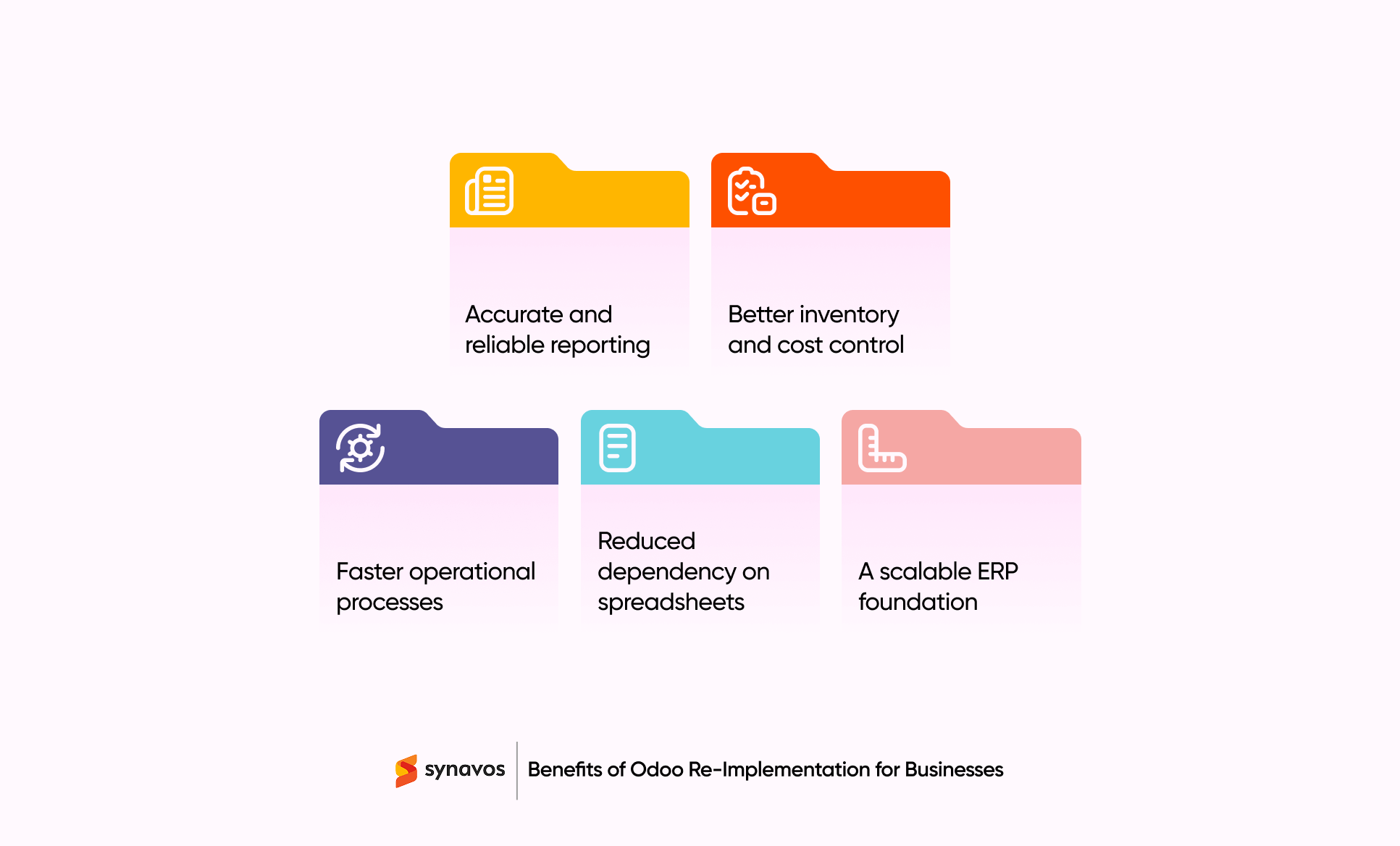
When re-implementation is done properly, benefits appear across the organization. Financial reporting becomes accurate and timely. Inventory and cost control improve. Manual work and spreadsheet dependency decrease. Operational cycles become more efficient. The system becomes scalable, supporting future growth without constant rework.
Most importantly, leadership regains confidence in data-driven decision-making.
Common Mistakes to Avoid During Odoo Re-Implementation
Businesses should avoid:
- Treating re-implementation as an IT-only task
- Repeating excessive customization
- Migrating poor-quality data
- Rushing go-live without stabilization
- Skipping structured user training
How to Choose the Right Odoo Re-Implementation Partner
Odoo re-implementation is not something you outsource and forget. It is a process you go through with a partner. The quality of that collaboration will shape not only the outcome of the project, but also how confident your teams feel using the system afterward.
When you speak with potential partners, here are the signals that matter most.
-
A Partner Who Wants to Understand Your Business First
Before discussing modules or features, the right partner will spend time understanding how your business actually works today. They will ask about:
- How decisions are made
- Where teams struggle day to day
- Which reports leadership trusts, and which they don’t
- What growth looks like for you over the next few years
-
Choose Someone Who Is Comfortable Challenging the Status Quo
Re-implementation is a chance to fix things that quietly stopped working. That only happens if your partner is willing to ask difficult questions.
A good partner will not blindly automate every existing step. Instead, they will help you examine whether certain approvals, workarounds, or legacy practices still make sense.
-
Trust Experience, Not Just Promises
Finally, look for credible implementation partners like Synavos who have experience working with ERP systems that were already live, but no longer working well.
Re-implementation requires a different perspective than the first-time setup. Experience in correcting misalignment, simplifying complexity, and restoring trust in data makes a meaningful difference.
What Should You Do Next?
If your Odoo system feels heavy, unreliable, or overly dependent on manual work, it may be time to step back and assess, rather than rushing into fixes, to understand the real issue.
A focused ERP health check from a credible ERP implementation partner can reveal whether re-implementation is needed, where the biggest risks lie, and what a realistic path forward looks like. The right reset doesn’t just fix problems. It restores clarity, confidence, and control so your ERP supports growth instead of slowing it down.

How Synavos Can Help?
At Synavos, we have a proven track record of working with growing and complex organizations that reached this exact point, where Odoo was live, but no longer delivering clarity, control, or confidence. Our experience spans businesses operating across Pakistan, Saudi Arabia (KSA), and the United Arab Emirates (UAE).
Through structured ERP re-implementation initiatives, Synavos has helped companies clean up years of accumulated complexity, realign processes with actual operations, restore trust in reporting, and build ERP environments that scale with the business rather than slow it down.
Need an Odoo ERP Health Check? Let's talk!