Re-implementing Odoo is a major step toward fixing process inefficiencies, improving visibility, and aligning the system with current business needs. But go-live is not the end of the journey. Businesses that want lasting value must actively maintain Odoo after re-implementation to keep the platform efficient, stable, and aligned with operational goals.
Many companies assume that once Odoo has been re-implemented, it will continue performing well on its own. That rarely happens. Over time, even a well-planned system can lose momentum if there is no structure behind ownership, performance monitoring, user training, data quality, and change management. To maintain Odoo re-implementation, businesses need a long-term strategy rather than a one-time project mindset.
Below are seven best practices that help keep Odoo running smoothly long after re-implementation is complete.
1. Assign Clear Ownership Across the System
One of the biggest reasons businesses struggle after go-live is the lack of clear ownership. When no one is directly responsible for Odoo, decisions are delayed, issues remain unresolved, and improvement requests start piling up without direction.
To maintain Odoo after re-implementation, businesses should define clear responsibilities across the system. This includes identifying who owns the platform internally, who handles functional decisions, who approves process changes, and who coordinates with the implementation or support partner. Ownership does not have to sit with one person alone, but the structure must be clear.
2. Monitor System Performance Regularly
Businesses should not wait until users start complaining before reviewing performance. A reactive approach usually leads to avoidable disruptions, frustrated teams, and slower operations.
A better approach is to monitor system performance on a regular basis. This includes checking transaction speed, workflow delays, reporting issues, integration failures, recurring support requests, and general user feedback. Even small slowdowns can affect productivity when multiple departments rely on Odoo every day.
If the goal is to maintain Odoo after re-implementation, regular monitoring is essential. It helps businesses catch issues early, identify patterns before they become serious, and make informed decisions about future improvements.
3. Keep Customizations Under Control
Re-implementation often gives businesses the chance to remove unnecessary customizations that caused complexity in the first place. That progress should not be undone by approving every new change request without proper evaluation.
Before introducing a customization, businesses should ask a few practical questions. Does it solve a real operational problem? Is it truly necessary? Will it affect upgrades, reporting, or future maintenance?
Too many customizations make Odoo harder to test, support, and scale. They also increase long-term maintenance costs. Businesses that want to maintain Odoo after re-implementation successfully need a disciplined process for reviewing and approving changes. Simplicity usually wins over short-term convenience.
4. Continue User Training After Go-Live
User training should never stop at go-live. In fact, one of the most effective ways to maintain Odoo after re-implementation is to continue training users as the system evolves.
At the beginning, teams may understand the new workflows well enough to operate. But over time, knowledge gaps start to appear. New employees join, existing users develop inefficient shortcuts, and some teams begin relying on workarounds that reduce consistency and create avoidable errors.
Ongoing training helps prevent those issues. Businesses should run refresher sessions, provide role-based guidance, and offer onboarding support for new hires. Training should also cover common mistakes, process updates, and practical ways to use Odoo more effectively in day-to-day operations.
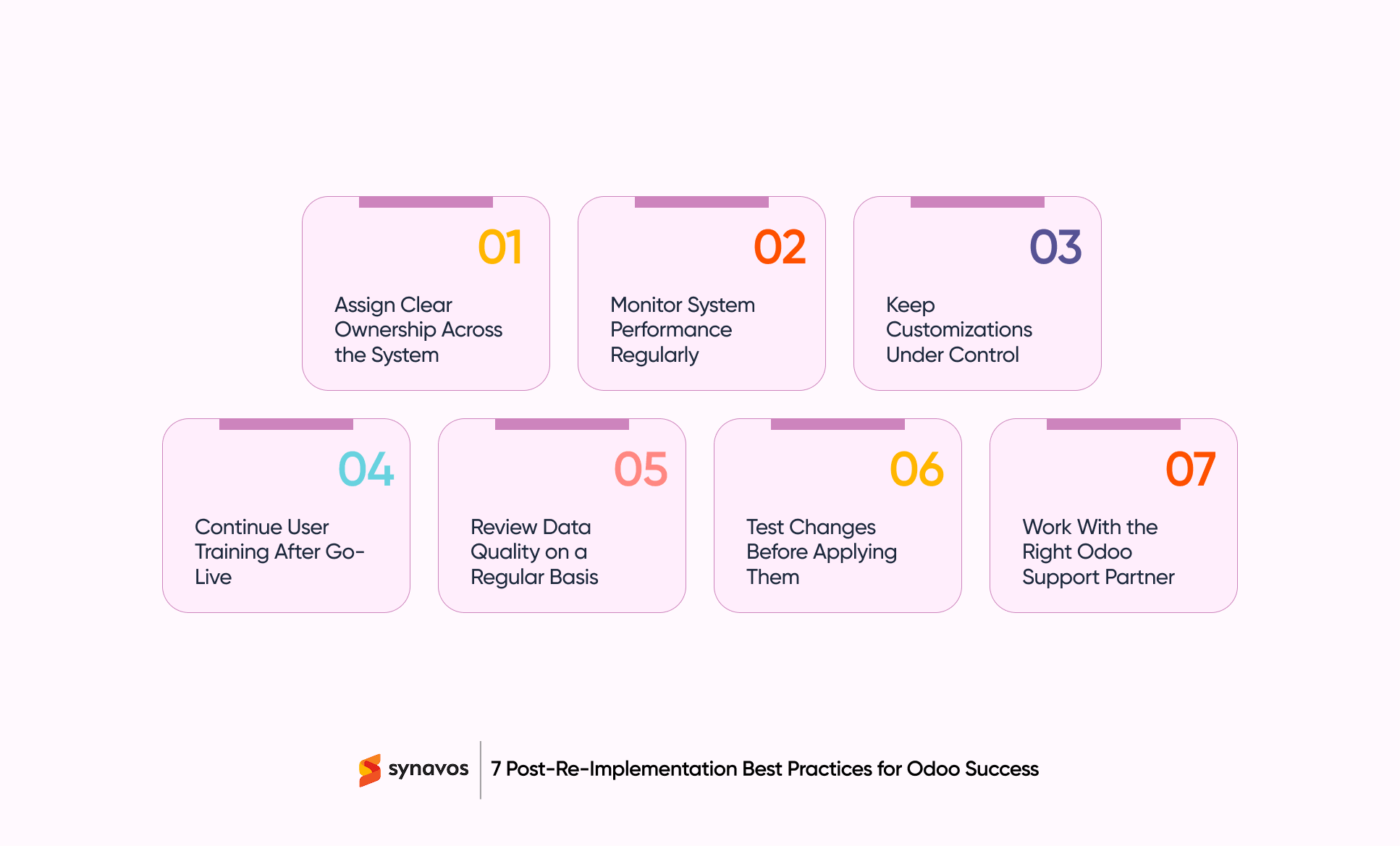
5. Review Data Quality Regularly
An ERP implementation is only as useful as the data inside it. No matter how well Odoo is configured, poor data quality will eventually affect reporting, operations, forecasting, and decision-making.
Businesses should review master data, duplicate records, incomplete fields, outdated information, inconsistent naming conventions, and process-related entry errors on a regular basis. If these issues are ignored, the system becomes harder to trust. Reports lose accuracy, cross-department visibility weakens, and teams begin making decisions based on unreliable information.
To maintain Odoo after re-implementation, data quality must become part of the normal business discipline. Clean and structured data supports better control, stronger reporting, and more meaningful use of the system across the organization.
6. Test Every Change Before It Goes Live
Even small changes can create large operational problems when they are applied without proper testing. A minor workflow adjustment may interrupt approvals. A report update may change data visibility. A customization may affect another module in unexpected ways.
That is why testing should be standard practice after re-implementation. Businesses should validate every fix, enhancement, workflow update, report change, and integration adjustment before moving it into the live environment.
If the business wants to maintain Odoo after re-implementation without unnecessary disruption, a structured testing process is non-negotiable. Testing reduces risk, improves system stability, and gives stakeholders more confidence in every change.
7. Work With the Credible Odoo Implementation Partner
Internal teams may understand the business well, but long-term Odoo success often depends on having the right external support as well. A reliable Odoo implementation partner plays an important role in helping businesses move beyond day-to-day issue resolution toward continuous improvement.
The right support partner does more than respond to tickets. They help identify risks, review change requests, guide process decisions, improve workflows, and support future growth plans. This becomes especially valuable when businesses are scaling operations, facing technical challenges, or trying to optimize how Odoo supports different departments.
For organizations that want to maintain Odoo after re-implementation, the support partner should be seen as a strategic resource, not just a technical vendor. The right relationship helps businesses protect system quality while continuing to improve performance over time.
Final Thoughts
At Synavos, we understand that maintaining Odoo after re-implementation requires more than technical support alone. It takes a structured, business-focused approach that keeps the system aligned with real operational needs as the business evolves. As an Odoo silver partner, Synavos has a proven track record of helping organizations strengthen post-go-live performance through ongoing support, controlled improvements, user enablement, data discipline, and process optimization.
Need a reliable partner to keep Odoo optimized? Let's talk!