When budgets are discussed, cybersecurity is often grouped under risk prevention. It sits there as a necessary expense, justified by the fear of what could go wrong.
But that view is incomplete.
The truth is, enterprise cybersecurity does far more than prevent breaches. It strengthens how your business operates, how customers perceive you, and how confidently you pursue growth. Many of its most valuable returns are not loud or dramatic. They show up quietly in smoother operations, faster deals, stronger partnerships, and long term resilience.
In this blog, we will look beyond the obvious and uncover five hidden benefits that make cybersecurity one of the smartest investments an enterprise can make.
Why Enterprises Often Underestimate the Value of Cybersecurity
Cybersecurity budgets are often justified by worst case scenarios. Data loss. Regulatory fines. Reputation damage.
The problem is that avoided disasters are hard to measure. When nothing happens, it feels like nothing was gained.
Another issue is ownership. Security is often treated as an IT function rather than a business priority. When leadership does not connect security to revenue, customer trust, or investor confidence, its full value remains hidden.
Now let us uncover what that value actually looks like.
1. Stronger Customer Trust and Brand Reputation
Customers may not read your security policy, but they care deeply about how you handle their data.
Enterprises that demonstrate strong security practices build confidence. This trust becomes even more important in industries handling financial, healthcare, or identity data.
One public incident can damage brand equity overnight. On the other hand, a reputation for security strengthens customer loyalty and long term retention. Trust is hard to win and easy to lose. Cybersecurity protects it quietly in the background.
2. Faster Business Growth
Many enterprises discover that strong cybersecurity opens doors.
Large clients and regulated industries often require proof of security maturity before signing contracts. If your controls, policies, and risk management practices are already in place, approvals move faster.
Security readiness also helps during RFP processes. When you can confidently answer security questionnaires, you remove friction from sales cycles.
In this way, cybersecurity becomes a growth enabler rather than a barrier.
3. Better Operational Efficiency
Cyber incidents create chaos. Systems go offline. Teams scramble. Productivity drops.
A well-structured cybersecurity program reduces these disruptions. Clear governance, defined access controls, and continuous monitoring bring order to IT operations.
When patch management is consistent and roles are clearly defined, there are fewer emergency fixes and less firefighting. Over time, this stability improves overall efficiency across departments.
Good security practices often lead to better organized technology environments.
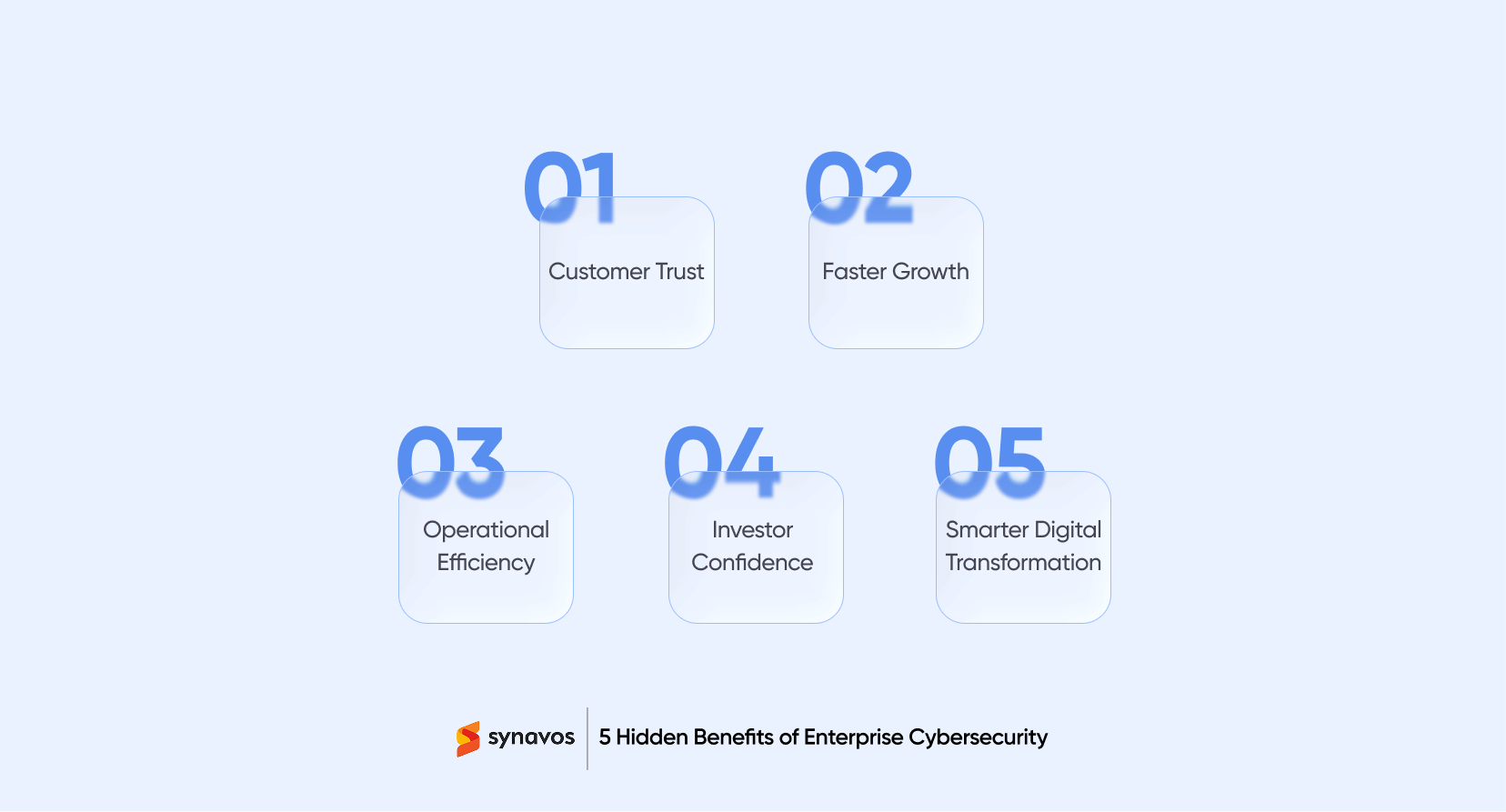
4. Improved Investor and Board Confidence
Investors and board members increasingly evaluate cybersecurity maturity when assessing risk.
A strong security posture signals responsible leadership and operational discipline. It reduces uncertainty around potential financial shocks caused by cyber incidents.
During funding rounds, mergers, or acquisitions, due diligence often includes deep security reviews. Enterprises with documented risk management processes and aligned frameworks, such as those recommended by the National Institute of Standards and Technology or the International Organization for Standardization, tend to inspire greater confidence.
In some cases, mature cybersecurity practices can even support stronger valuations.
5. Smarter Technology and Digital Transformation Decisions
Digital transformation brings opportunity, but also risk.
Cloud migration, remote work models, new SaaS tools, and AI adoption all introduce new exposure points. When cybersecurity is embedded into decision making, innovation becomes safer and more sustainable.
Instead of asking “Can we deploy this?” teams start asking “How do we deploy this securely?”
This shift reduces costly rework later and ensures new initiatives align with enterprise risk tolerance.
Common Misconceptions About Cybersecurity Investment
Some enterprises delay cybersecurity investment because they believe they have never been attacked. In reality, many cyber attacks go undetected.
Others assume cyber insurance is enough. Insurance may help with financial recovery, but it does not repair brand damage or restore lost trust.
There is also a belief that security slows innovation. Poorly planned security can create friction. Well designed security enables confident growth.
Conclusion
Cybersecurity is often justified by what it prevents. Its real value goes further than that.
It builds trust, supports growth, improves operational stability, and strengthens investor confidence. When viewed through this broader lens, cybersecurity stops being a defensive expense.
It becomes a strategic investment that supports the long term health of the enterprise.
Strengthen Your Enterprise Cybersecurity with Synavos
At Synavos, we specialize in designing, developing, and deploying custom cybersecurity solutions tailored to enterprise environments. Our expertise helps organizations build secure and resilient digital infrastructures aligned with modern security frameworks.
Contact Synavos today for a free cybersecurity assessment and discover how your enterprise can strengthen its security posture for the future.