Odoo is designed to simplify operations, connect departments, and give leadership clear visibility into the business. When it’s implemented well, it quietly becomes the backbone of daily decision-making.
However, when an Odoo implementation starts failing, the symptoms rarely appear all at once. Instead, problems surface gradually. What begins as a small workaround slowly turns into frustration. Over time, teams lose confidence in the system, and management begins to question the data coming out of it.
If you’re facing Odoo performance problems, these seven signs will help you determine whether your implementation or potential Odoo re-implementation needs serious attention.
1. Low Odoo User Adoption Across Teams
One of the earliest signs of a failing Odoo implementation shows up in user behavior. When teams start:
- Maintaining parallel Excel sheets
- Recording data outside the system
- Updating Odoo only after work is completed
It’s usually not resistance to technology. More often, it’s a signal that Odoo no longer reflects how work actually happens.
As adoption declines, data quality suffers. Once trust in the system erodes, Odoo slowly turns into a reporting formality rather than an operational tool, one of the most common long-term Odoo implementation issues seen in growing organizations.
2. Odoo Reports Are No Longer Trusted
At first glance, dashboards may look fine. Numbers are there. Filters work. Reports are generated on time. Yet something feels off. Leadership begins by asking:
- “Why doesn’t this match finance?”
- “Which report is correct?”
- “Let’s verify this manually.”
When Odoo stops acting as a single source of truth, decision-making slows down. Over time, unreliable reporting turns into missed opportunities and cautious planning. When Odoo is not working properly at the reporting level, the problem becomes strategic, not technical.
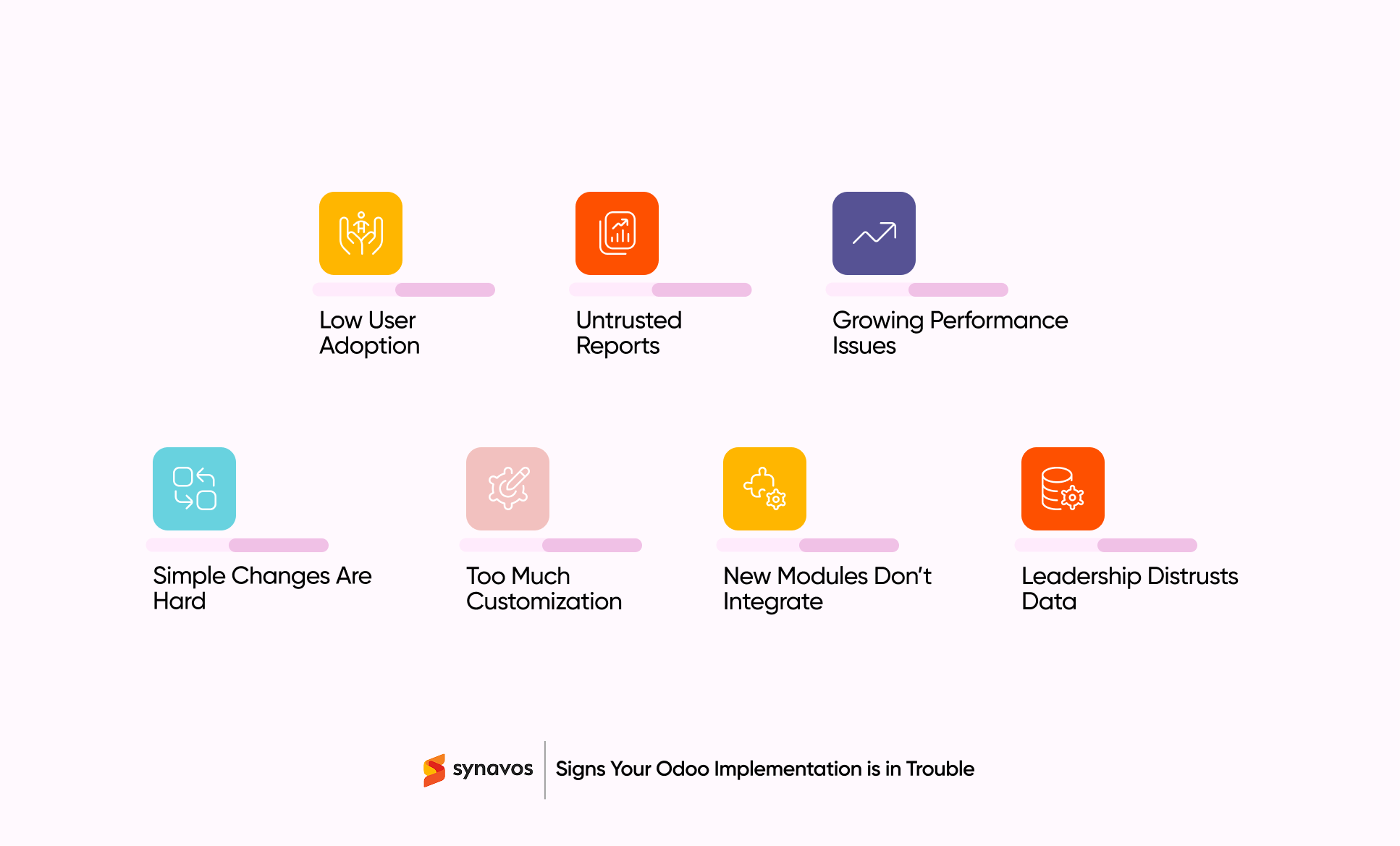
3. Odoo Performance Problems Increase Over Time
Performance issues are often the most visible sign of a failing Odoo implementation. If users complain about:
- Slow screen loading
- System lag during peak hours
- Delays in confirming transactions
The issue is rarely just infrastructure. In most cases, Odoo performance problems are caused by inefficient customizations, poorly designed workflows, excessive automation, or data structures that were never designed to scale.
As transaction volume increases, these weaknesses become impossible to ignore.
4. Simple Changes Have Become Complex
Businesses evolve constantly. New approval layers are added. Reporting needs change. Processes get refined.
In a healthy setup, these adjustments are manageable through configuration. However, if even minor changes require developer involvement or risk breaking existing workflows, it’s a sign the system has become fragile.
When Odoo resists change instead of supporting it, operational agility disappears.
5. Too Many Customizations, Little Control
Customization is one of Odoo’s strengths, until it’s not. However, warning signs include:
- Custom features no one fully understands
- No documentation explaining why changes were made
- Fear of upgrades because “something might break.”
At this stage, Odoo begins to feel locked. The system still runs, but it can no longer evolve safely. Many businesses reach this point knowing something is wrong, yet unsure how to move forward without disruption.
6. New Odoo Modules Don’t Work Smoothly
Odoo is designed to grow with your business. New modules should extend functionality smoothly. However, if every new module:
- Disrupts existing workflows
- Requires extensive rework
- Creates reporting inconsistencies
It often means the original implementation lacked a clear, process-driven design. The system may still function, but it is no longer extensible, undermining one of Odoo’s biggest advantages.
7. Leadership Distrusts Odoo Data
This is the most critical sign of all. When executives:
- Avoid dashboards
- Ask teams to manually confirm numbers
- Delay decisions due to uncertainty
The ERP implementation has failed in its core purpose.
At this stage, the issue goes beyond software. It affects confidence, planning, and long-term growth. Continuing with patches and workarounds usually increases complexity rather than solving the real problem.
Why Fixes and Workarounds Stop Working
Many organizations respond to these symptoms with:
- Additional customizations
- More user training
- Temporary operational workarounds
While these measures may provide short-term relief, they rarely resolve structural issues. Over time, costs increase, performance declines further, and trust in the system continues to erode.
Eventually, businesses are forced to ask a more fundamental question:
Does our Odoo system still reflect how we operate today, or is it time to reassess through structured Odoo re-implementation?
Final Words
As businesses grow and processes evolve, even well-intentioned Odoo implementations can lose alignment with real operational needs. What may have started as a streamlined system can gradually turn into a source of frustration, slow performance, unreliable reports, and workarounds that undermine efficiency and confidence. These are not just technical hiccups; they are signals that your ERP system may no longer be supporting how your teams actually work.
Recognizing these signs early gives you the opportunity to address the root causes rather than keep applying temporary fixes that add complexity without lasting benefit. A thoughtful, structured approach to revisiting your Odoo setup can restore performance, reinforce data trust, and realign the system with your business strategy.

How Synavos Can Help
Synavos has helped organizations across Pakistan, the Kingdom of Saudi Arabia (KSA), and the United Arab Emirates (UAE) overcome complex ERP and Odoo challenges by realigning ERP systems with real business processes.
Our experience spans multiple industries, and our work is backed by practical case studies where we’ve improved performance, reporting accuracy, user adoption, and long-term scalability.
Evaluating different re-implementation options? Explore our detailed Odoo re-implementation guide or book a consultation call to discuss your current setup and possible paths forward.