AI chatbots are now part of everyday business operations. They handle customer queries, collect leads, support transactions, and often sit at the first point of interaction between a user and a company. That also means they deal with sensitive information more often than most teams realize.
As adoption grows, security and compliance stop being optional and become part of the core product decision. A chatbot that is fast and helpful but unsafe can create more problems than it solves. This guide breaks down the real risks, compliance expectations, and practical steps businesses should understand before building or deploying an AI chatbot.
Why AI Chatbot Security Matters
AI chatbots are not just simple tools answering FAQs anymore. They connect with internal systems, process user data, and often rely on third-party APIs to function properly.
This creates a wider attack surface compared to traditional web forms or static systems. Every input from a user becomes a potential data point, and every integration becomes a potential entry point.
Key reasons chatbot security risks increase include:
- Continuous real-time data exchange with users
- Integration with CRMs, payment systems, and databases
- Storage of conversation history for training or analytics
- Use of external AI models and APIs
As chatbots become more connected and data-driven, security needs to be considered from the very beginning of development. You can learn how this is done in our “AI Chatbot Development Guide for Businesses [2026 Edition].”
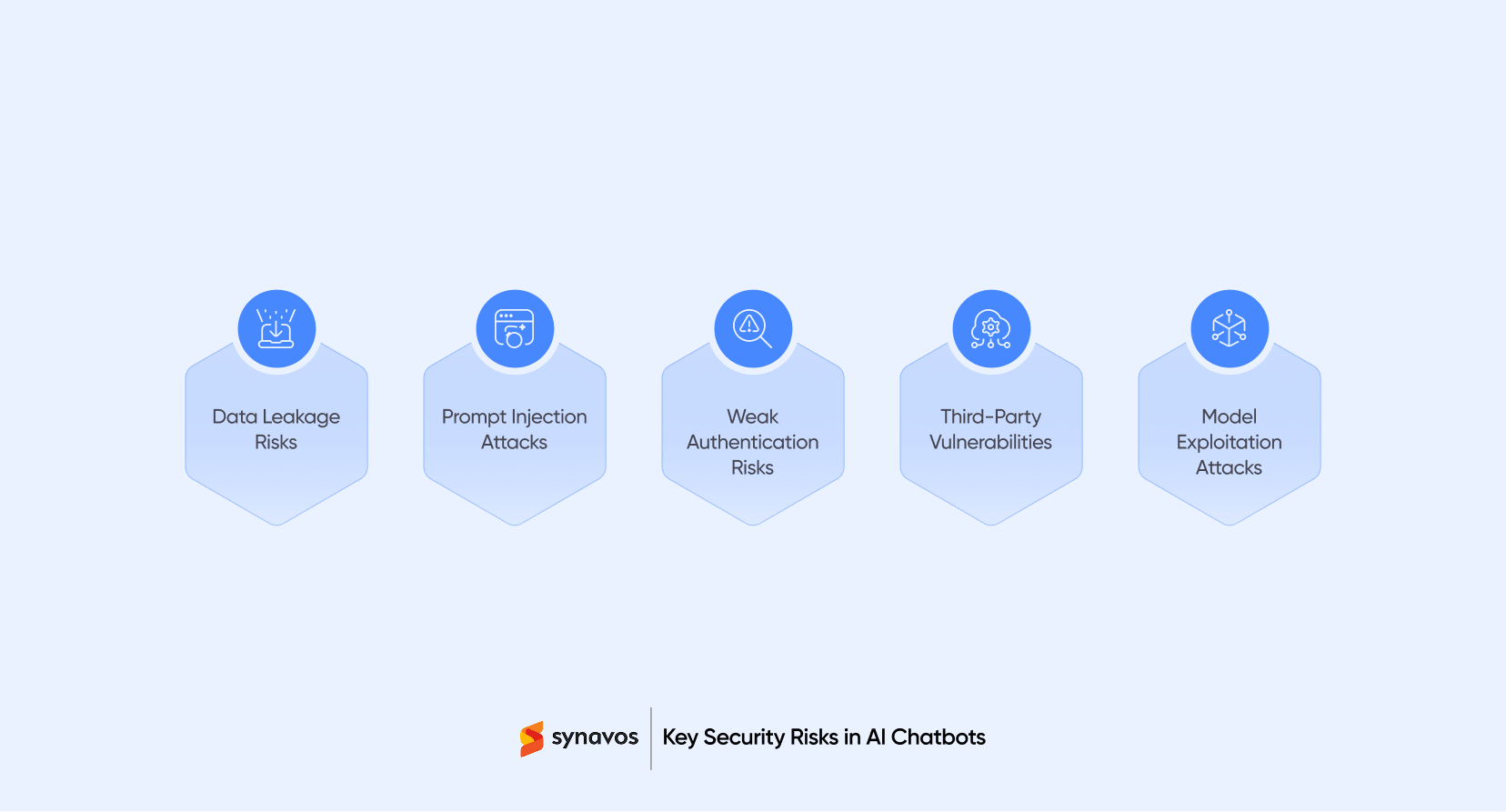
Key Security Risks in AI Chatbots
AI chatbots are exposed to a range of security threats due to their reliance on data processing, integrations, and natural language inputs. Understanding these risks is crucial for building secure and reliable chatbot systems.
Data Leakage and Privacy Risks
Chatbots frequently process large volumes of user data, including personally identifiable information, financial details, and confidential business inputs. If proper safeguards are not in place, this data can be exposed through logs, training datasets, or even chatbot responses.
One common issue arises when chatbots retain conversation history without adequate encryption or access controls. In some cases, models may also inadvertently surface sensitive information if they were trained on unfiltered or proprietary data. Poorly configured storage systems, lack of data masking, and excessive data collection further increase the risk.
To mitigate this, businesses must enforce strict data governance policies, limit data retention, and ensure sensitive information is never unnecessarily stored or reused.
Prompt Injection and Manipulation Attacks
Prompt injection is one of the most unique and emerging threats in AI chatbot security. In this type of attack, malicious users craft inputs designed to override the chatbot’s instructions or manipulate its behavior.
For example, an attacker might trick the chatbot into ignoring its safety rules, exposing internal logic, or retrieving restricted information. These attacks can be subtle and difficult to detect, especially in systems that rely heavily on dynamic inputs.
Without proper input validation and contextual safeguards, chatbots may follow malicious instructions as if they were legitimate queries. This can lead to data exposure, policy violations, or unintended system actions.
Implementing input filtering, output validation, and layered instruction controls is essential to reduce the effectiveness of such attacks.
Unauthorized Access and Weak Authentication
AI chatbots often integrate with internal systems such as CRMs, databases, and customer accounts. If authentication and authorization mechanisms are weak, attackers can exploit these connections to gain unauthorized access.
For instance, a chatbot without proper user verification may allow access to sensitive account information based solely on minimal input. Similarly, lack of role-based access control can expose administrative functions to unintended users.
Session hijacking, credential stuffing, and API abuse are also common risks when authentication is not robust. Over time, these vulnerabilities can lead to large-scale data breaches or system compromise.
Businesses should implement multi-factor authentication, enforce strict identity verification, and ensure that access permissions are tightly controlled based on user roles.
Third-Party Integration Vulnerabilities
Modern chatbots rarely operate in isolation. They depend on third-party APIs, plugins, and external AI models to deliver functionality. While this enhances capabilities, it also expands the attack surface.
If a third-party service has weak security practices, it can become an entry point for attackers. Data shared with external providers may also be exposed if proper encryption and contractual safeguards are not in place. Additionally, unmonitored API calls can be exploited for data scraping or denial-of-service attacks.
Supply chain risks are particularly concerning, as businesses often have limited visibility into how third-party vendors handle security internally.
To address this, organizations should conduct thorough vendor assessments, monitor API activity, and implement strict data-sharing controls with all external partners.
Model Exploitation and Adversarial Attacks
AI models can be manipulated using specially crafted inputs known as adversarial attacks. These inputs are designed to confuse the model, causing it to produce incorrect, misleading, or even harmful outputs.
In some cases, attackers may attempt model extraction, where they systematically query the chatbot to replicate its underlying logic or steal proprietary information. Others may exploit biases in the model to generate inappropriate or non-compliant responses.
These risks are particularly critical in industries where accuracy and trust are essential, such as healthcare, finance, or legal services. A compromised model can lead to poor decision-making and reputational damage.
Mitigating these risks requires continuous model testing, monitoring for abnormal behavior, and implementing safeguards such as output filtering and human review for sensitive interactions.
Top Data Privacy and Compliance Laws for AI Chatbots in 2026
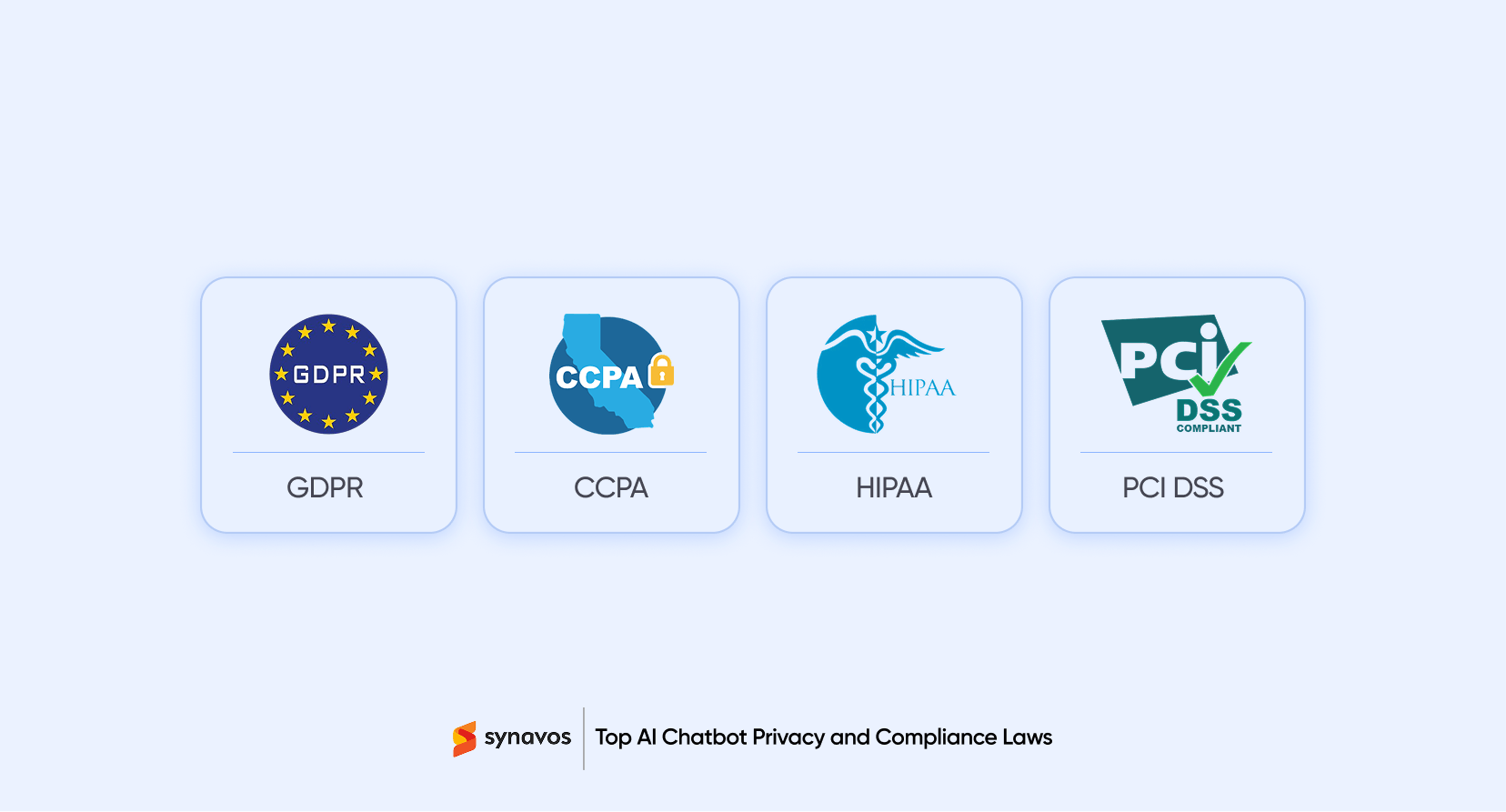
AI chatbots must comply with various global data protection and privacy laws depending on the type of data they handle and the regions they operate in. These regulations define how user information should be collected, processed, and protected. The most important ones include the following standards:
GDPR (General Data Protection Regulation)
Applies to businesses handling EU user data. It emphasizes data protection, user consent, and the right to be forgotten.
CCPA/CPRA (California Privacy Laws)
Focus on transparency, data access rights, and consumer control over personal information.
HIPAA (Health Insurance Portability and Accountability Act)
Relevant for healthcare chatbots. It requires strict protection of patient data.
PCI DSS (Payment Card Industry Data Security Standard)
Applies to chatbots handling payment information to ensure secure processing and storage.
Businesses must also consider data residency laws and cross-border data transfer restrictions.
Best Practices for AI Chatbot Security
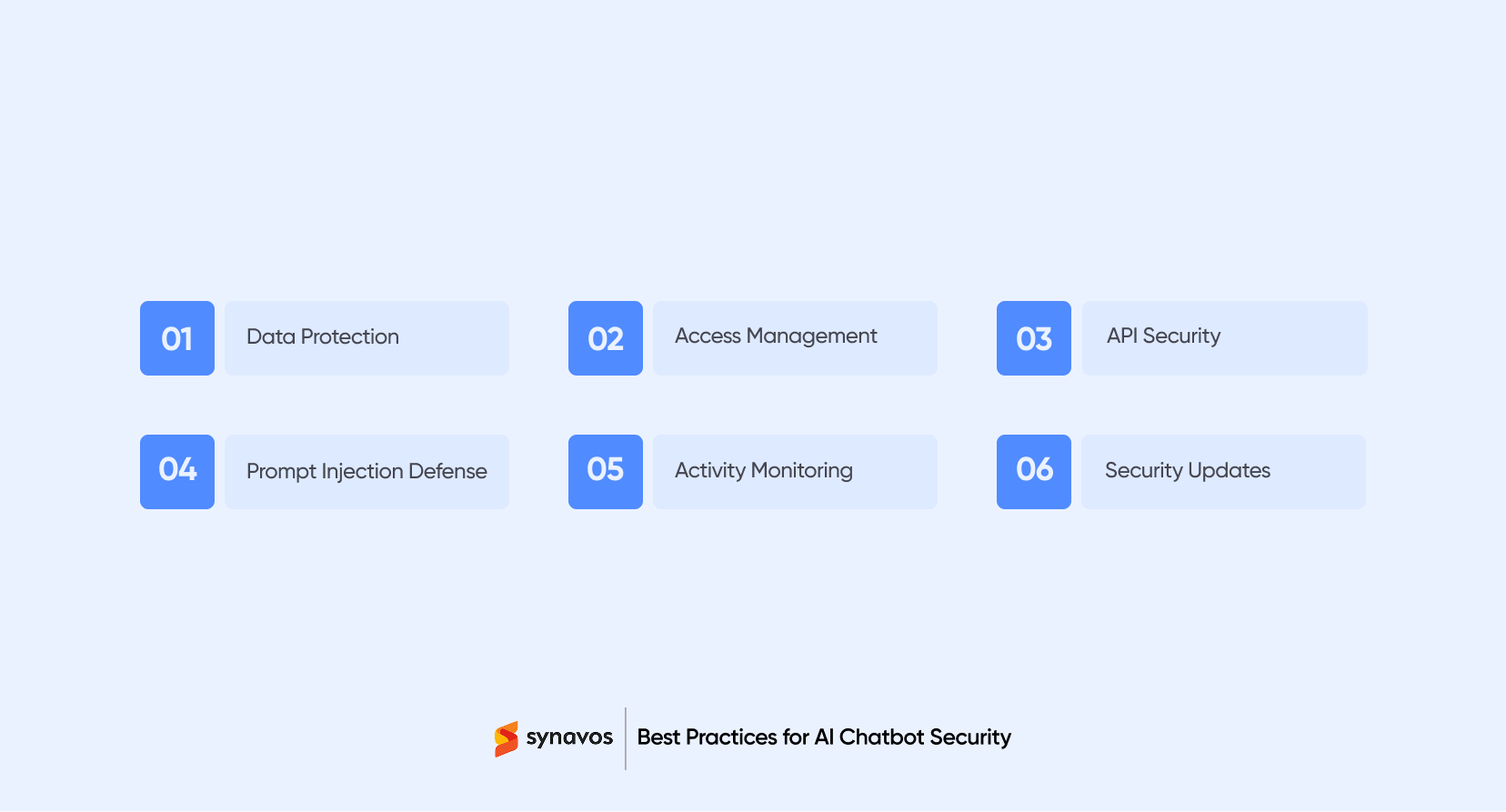
Securing AI chatbots requires a proactive approach that combines technology, processes, and continuous monitoring. Without the right safeguards, even advanced systems can become vulnerable. Some of the most effective best practices include the following:
1. Implement Strong Data Protection Measures
Protecting user data should be the foundation of any AI chatbot security strategy. Businesses must ensure that all sensitive information is encrypted both in transit and at rest to prevent unauthorized access. Data minimization should also be applied, meaning the chatbot only collects information that is absolutely necessary for its function.
In addition, organizations should define clear data retention policies to avoid storing user data longer than required. Sensitive information should be anonymized or tokenized wherever possible to reduce exposure risks in case of a breach.
2. Use Robust Authentication and Access Control
Strong authentication mechanisms are essential to prevent unauthorized access to chatbot systems and connected platforms. Multi-factor authentication (MFA) should be implemented for administrators and users accessing sensitive functionalities. This adds an extra layer of protection beyond just passwords.
Role-based access control (RBAC) should also be enforced to ensure users only access the data and features relevant to their role. Regular access reviews help identify and remove unnecessary permissions, reducing the risk of internal misuse or external exploitation.
3. Secure APIs and Third-Party Integrations
Since most chatbots rely heavily on APIs and external services, securing these integrations is critical. All APIs should be protected using authentication tokens, rate limiting, and secure gateways to prevent abuse or unauthorized data extraction.
Businesses should also evaluate third-party vendors for their security standards before integration. Continuous monitoring of API activity helps detect anomalies early and prevents potential supply chain attacks.
4. Protect Against Prompt Injection and AI-Specific Attacks
AI chatbots are vulnerable to prompt injection attacks where malicious inputs manipulate system behavior. To mitigate this, businesses should implement input validation, context filtering, and strict system instructions that cannot be overridden by user prompts.
Output filtering should also be used to ensure the chatbot does not reveal sensitive or restricted information. Regular testing against adversarial inputs helps strengthen resilience against evolving AI-specific threats.
5. Monitor, Log, and Audit All Chatbot Activity
Continuous monitoring is essential for identifying suspicious behavior in real time. Logging all chatbot interactions helps create an audit trail that can be used for security analysis and compliance reporting.
These logs should be securely stored and regularly reviewed to detect anomalies such as repeated failed access attempts or unusual data requests. Effective monitoring also supports faster incident response in case of a security breach.
6. Conduct Regular Security Testing and Updates
AI chatbot systems should undergo regular vulnerability assessments and penetration testing to identify weaknesses before attackers do. This includes testing both the application layer and AI model behavior under different attack scenarios.
Frequent updates and patch management are equally important to fix known vulnerabilities and improve system resilience. A proactive maintenance approach ensures the chatbot remains secure against evolving threats.
Conclusion
AI chatbots are powerful, but they sit at a sensitive intersection of data, automation, and user interaction. That makes security and compliance a core part of their design, not an afterthought.
Businesses that treat security seriously from the beginning avoid future risks and build stronger trust with users. In a space where data is constantly flowing, control and clarity are what separate a useful chatbot from a risky one.
Build Secure & Compliant AI Chatbot with Synavos
A chatbot might look good on the surface, but what really matters is how it handles data behind the scenes.
At Synavos, we help businesses create AI chatbots that are built with care, from security to integrations to long-term performance. As a leading AI chatbot development company, we keep things practical and focused on what actually works in production.
Let’s talk and map out the right approach for you!