For many growing businesses, disconnected systems and outdated workflows create a constant struggle to keep up. The reliance on spreadsheets, manual approvals, and fragmented software leads to inefficiencies, delayed decisions, and missed opportunities. This is where the power of an efficient ERP system comes in.
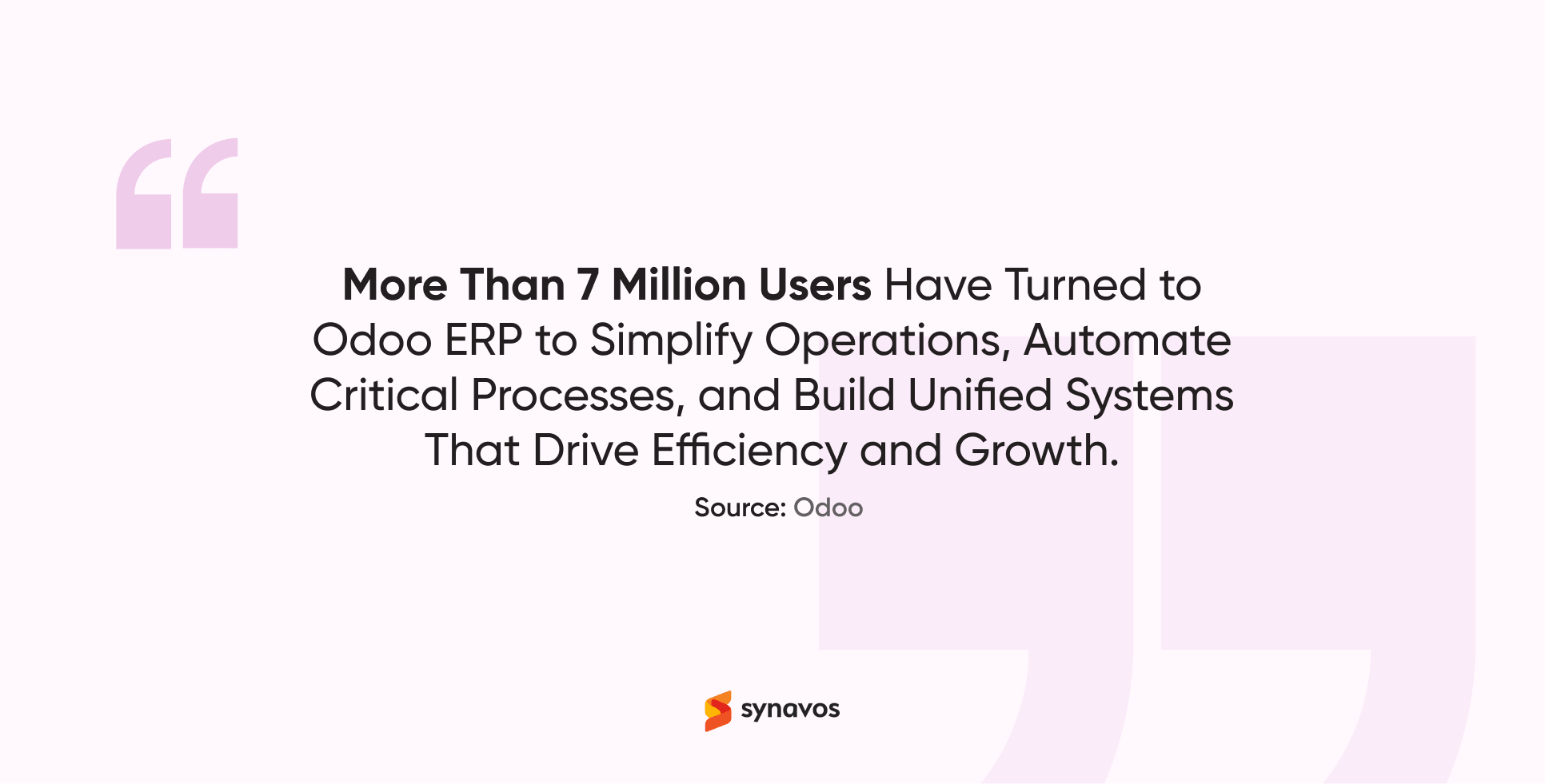
As of Odoo reports in 2024, over 7 million users worldwide have turned to Odoo ERP to streamline operations, automate processes, and create a unified system that drives efficiency.
Therefore, by centralizing all business functions, sales, inventory, and finance, Odoo ERP helps businesses make smarter, data-driven decisions faster, gaining a significant competitive edge.
Wondering if your business needs Odoo implementation? Discover the key signs inside.
1. Teams Are Working in Silos
One of the clearest signs your business needs an ERP system is when every department is using a different tool.
Your sales team may be working in a CRM. Your finance team may be using accounting software. Your inventory team may be tracking stock in spreadsheets. Your management team may be asking for weekly reports from different departments just to understand what is happening.
This creates data silos.
The real issue is not only that teams are using separate systems. The bigger problem is that information does not flow smoothly between them. Sales may not know the real stock position. Finance may not know which orders are ready for invoicing. Operations may not know which customer commitments have already been made.
An Odoo ERP system solves this by connecting core departments in one place.
2. Excessive Dependency on Spreadsheets
Spreadsheets are helpful in the early stages of business. They are easy to create, quick to update, and familiar to almost everyone.
But as the business grows, spreadsheets become risky.
You may start seeing multiple file versions, formula errors, missing updates, duplicate records, and manual reconciliation problems. A sales forecast may be stored in one sheet, customer payments in another, stock levels in another, and purchase planning in a separate file.
This is where decision-making becomes slow.
For example, a finance manager may spend hours preparing reports because data has to be collected from different sheets. An operations manager may struggle to confirm stock availability because the spreadsheet is not updated in real time.
Odoo helps replace manual tracking with structured workflows, automated records, and real-time visibility.
3. Inventory Errors Disrupt Operations
Inventory issues are one of the most common signs that a business has outgrown its current systems.
If your team regularly deals with stock mismatches, overselling, delayed deliveries, manual stock adjustments, or unclear warehouse records, your inventory process needs better control.
Inventory problems usually happen when stock data is not connected with sales, purchasing, accounting, and warehouse operations.
For example, your sales team may confirm an order without knowing that the product is already reserved. Your warehouse team may discover stock shortages only when dispatch is due. Your purchasing team may reorder late because the minimum stock levels are not clearly visible.
An integrated inventory management system like Odoo helps businesses track stock movement, manage warehouses, connect sales with inventory, and improve replenishment planning.
4. Financial Reporting Takes Too Long
If your finance team needs several days to prepare reports, your business is likely operating with delayed visibility.
Financial reporting becomes slow when invoices, payments, expenses, sales orders, purchase orders, and stock valuation are managed in separate systems. The finance team then spends more time collecting and checking data than analyzing it.
This creates problems for leadership. CEOs and finance managers need timely answers to practical questions:
How much cash is available? Which customers have overdue invoices? Which products are most profitable? What is the real cost of operations? Where are margins being lost?
With finance and accounting automation, Odoo can connect invoices, payments, expenses, sales, purchases, and accounting records.
5. Sales and CRM Data Aren’t Connected
When sales and customer data are disconnected, teams lose opportunities.
A lead may come from a website form, but the sales team may track it in a separate sheet. A quotation may be sent manually. Follow-ups may depend on memory. Customer complaints may not be visible to account managers. Finance may not know which deals are expected to convert.
This creates a weak customer journey.
With sales and CRM management in Odoo, leads, opportunities, quotations, customers, sales orders, invoices, and follow-ups can be connected. This helps sales teams track the full journey from inquiry to payment.
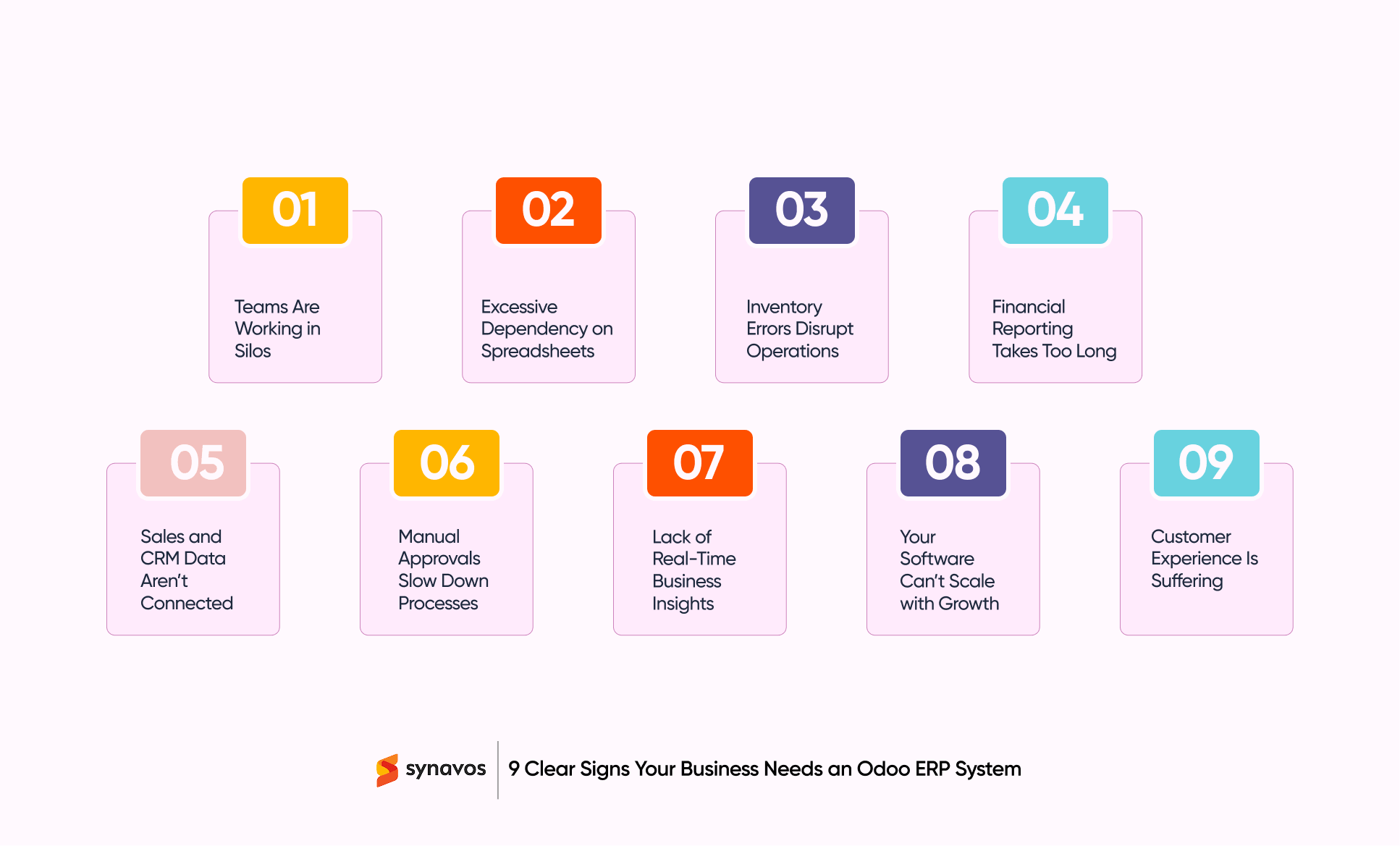
6. Manual Approvals Slow Down Processes
Manual approvals may look harmless, but they often become hidden bottlenecks.
Purchase approvals, quotation discounts, expense claims, vendor payments, stock transfers, and hiring requests may move through email, paper forms, or messaging apps. When the responsible person is unavailable, the process stops.
The problem is not only the delay. Manual approvals also reduce accountability. It becomes difficult to know who approved what, when it was approved, and whether the decision followed company policy.
An Odoo ERP system can help businesses create approval workflows with clear roles, rules, and records.
7. Lack of Real-Time Business Insights
Many businesses do not suffer from a lack of effort. They suffer from a lack of visibility.
When data is scattered, management depends on delayed reports and informal updates. By the time the numbers arrive, the situation may have already changed. This affects planning, forecasting, customer commitments, and cash flow decisions.
Real-time visibility means leadership can see what is happening across the business without chasing every department. This is where integrated business software becomes powerful. Odoo helps centralize operational data so decision-makers can move from guesswork to informed action.
For CEOs, COOs, and finance managers, visibility is not a luxury. It is the foundation of better control.
8. Your Software Can’t Scale with Growth
A system that worked for 10 employees may not work for 100.
As your business grows, you may add more locations, products, customers, warehouses, sales channels, and approval layers. The software you used in the early stage may become too limited. It may not support custom workflows, multi-company structures, advanced reporting, integrations, or industry-specific processes.
This is one reason many growing SMEs start looking for an ERP system for growing businesses.
Odoo’s modular structure allows businesses to begin with essential modules and add more applications as requirements evolve.
9. Customer Experience Is Suffering
Customers do not see your internal systems. They only experience the result.
If quotations are delayed, orders are missed, invoices are incorrect, deliveries are late, or support teams lack customer history, the customer experience suffers. Internally, the issue may be poor coordination. Externally, it looks like poor service.
With an integrated ERP platform, customer-facing teams can access better information. Sales can see order history. Finance can track invoices. Operations can check the delivery status. Support can understand previous interactions.
Why Odoo ERP Is a Smart Choice for Growing Businesses
Odoo implementation is a strong choice for any growing business because it combines flexibility, integration, and scalability. The first advantage is modularity. Businesses do not need to implement every module at once. They can begin with what they need most, such as CRM, sales, inventory, accounting, invoicing, or purchasing, and expand later.
The second advantage is automation. Odoo helps reduce repetitive manual work across quotations, invoicing, purchase orders, inventory updates, approvals, and reporting. In addition, Odoo’s official positioning focuses on being both easy to use and fully integrated, which is important for companies trying to move away from disconnected tools.
For a deeper understanding of how to implement Odoo in your business, including timelines, pricing details, and tips for selecting the right implementation partner, check out our Odoo Implementation Guide: Timeline, Pricing & Partner Selection.
How Synavos Helps Businesses Implement Odoo ERP Successfully
The foundation of a successful Odoo ERP implementation is a deep understanding of your business processes. Without clear workflows, approval rules, and data structures, automation can create more problems than solutions.
This is where Synavos supports businesses as the best Odoo ERP implementation partner.
Synavos, as an Odoo Silver Partner, is proud to have successfully implemented Odoo for businesses across the KSA, UAE, and Pakistan. With over 100 successful ERP implementations, we offer comprehensive services from system setup and customization to integration, training, and ongoing support, ensuring your Odoo system works exactly how your business needs it.
Want a smooth, successful Odoo implementation? Let’s talk today!