Odoo implementation is not just a software decision. It is an operational decision that affects how your teams work, how information moves across departments, and how efficiently your business can scale. That is why most companies evaluating Odoo ERP ask the same three questions first: How long will implementation take? How much will it cost? And how do we choose the right implementation partner?
Those questions matter because Odoo is designed to run a wide range of business functions in one platform, including CRM, sales, inventory, accounting, project management, HR, and more. Odoo itself describes the platform as an integrated suite of business apps built to cover company-wide needs, while emphasizing usability and integration across modules.
This guide explains the full picture for business leaders, operations teams, and decision-makers who want a practical understanding of Odoo implementation before investing time and budget into the project.
Why Odoo Implementation Needs a Strategy
Many businesses assume implementation starts when the software is installed. In reality, that is only a small technical step in a much bigger business process.
Odoo implementation is the structured process of shaping the platform around your business needs. That includes understanding your current workflows, identifying pain points, deciding which modules you need, configuring the system, planning data migration, handling integrations, testing everything properly, training users, and supporting the business after go-live.
This is why Odoo implementation should be treated as a business transformation project.
Not sure if Odoo ERP is right for your business? Here are 9 signs to help you decide.
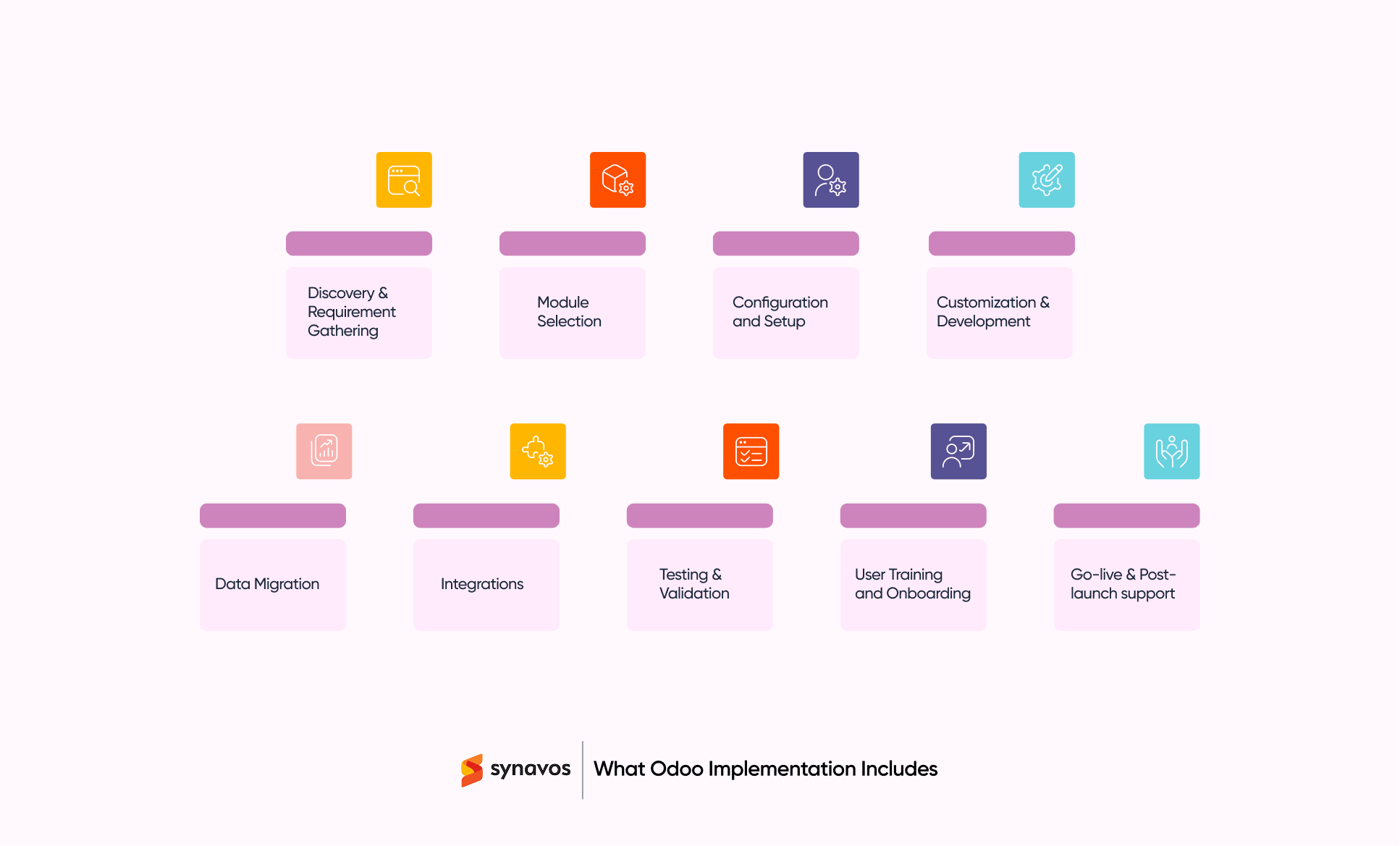
What Odoo Implementation Includes
A complete Odoo implementation project includes much more than setup. It usually moves through several connected stages, each one important to the final outcome.
Discovery & Requirement Gathering
This is the stage where the implementation team learns how your business works today. They study your workflows, bottlenecks, reporting needs, approval logic, user roles, and business goals. If this phase is shallow, the whole project becomes weaker.
Module Selection
Once requirements are clear, the team maps those needs into Odoo. This is where they define which modules should be used, where standard features are enough, and where customization may be required.
Configuration and Setup
This includes user roles, permissions, workflows, taxes, products, warehouses, accounting structures, approvals, pricing rules, and operational settings.
Customization & Development
If your business has needs that go beyond standard Odoo features, custom development may be added. That can include custom reports, forms, dashboards, workflows, portals, or integrations.
Data Migration
Your old data must be cleaned, mapped, validated, and imported into Odoo. This often includes customer records, supplier data, product lists, stock records, opening balances, historical transactions, and other core business data.
Integrations
Odoo may need to connect with websites, shipping providers, payment gateways, BI tools, banking systems, marketplaces, or other internal software.
Testing & Validation
Testing should cover real business scenarios, not just isolated screens. Sales to invoice, purchase to payment, stock receipt to delivery, service delivery to billing, and approval workflows should all be checked carefully.
User Training and Onboarding
Different teams need different training. Finance users, warehouse teams, managers, salespeople, and HR teams all use the platform differently.
Go-live & Post-launch support
Once the business starts using Odoo daily, there is usually a stabilization period where users need support, small changes may be required, and issues are resolved quickly.
How Long Does Odoo Implementation Take
One of the first questions every business asks is how long implementation will take. The honest answer is that there is no single fixed timeline, because scope and complexity vary from company to company. Still, there are realistic ranges that can help businesses plan.
Small Business Timelines
A smaller company with straightforward workflows, a focused scope, limited users, and minimal customization may complete implementation in around 4 to 8 weeks.
Mid-Sized Business Implementation Timeline
A growing company with multiple departments, more process dependencies, moderate custom work, and some migration or integration effort may need around 2 to 4 months.
Enterprise or Complex Implementation Timeline
A larger business with multiple legal entities, deeper process complexity, advanced reporting, custom workflows, heavy integrations, or phased rollout requirements may need 4 to 9 months or more.
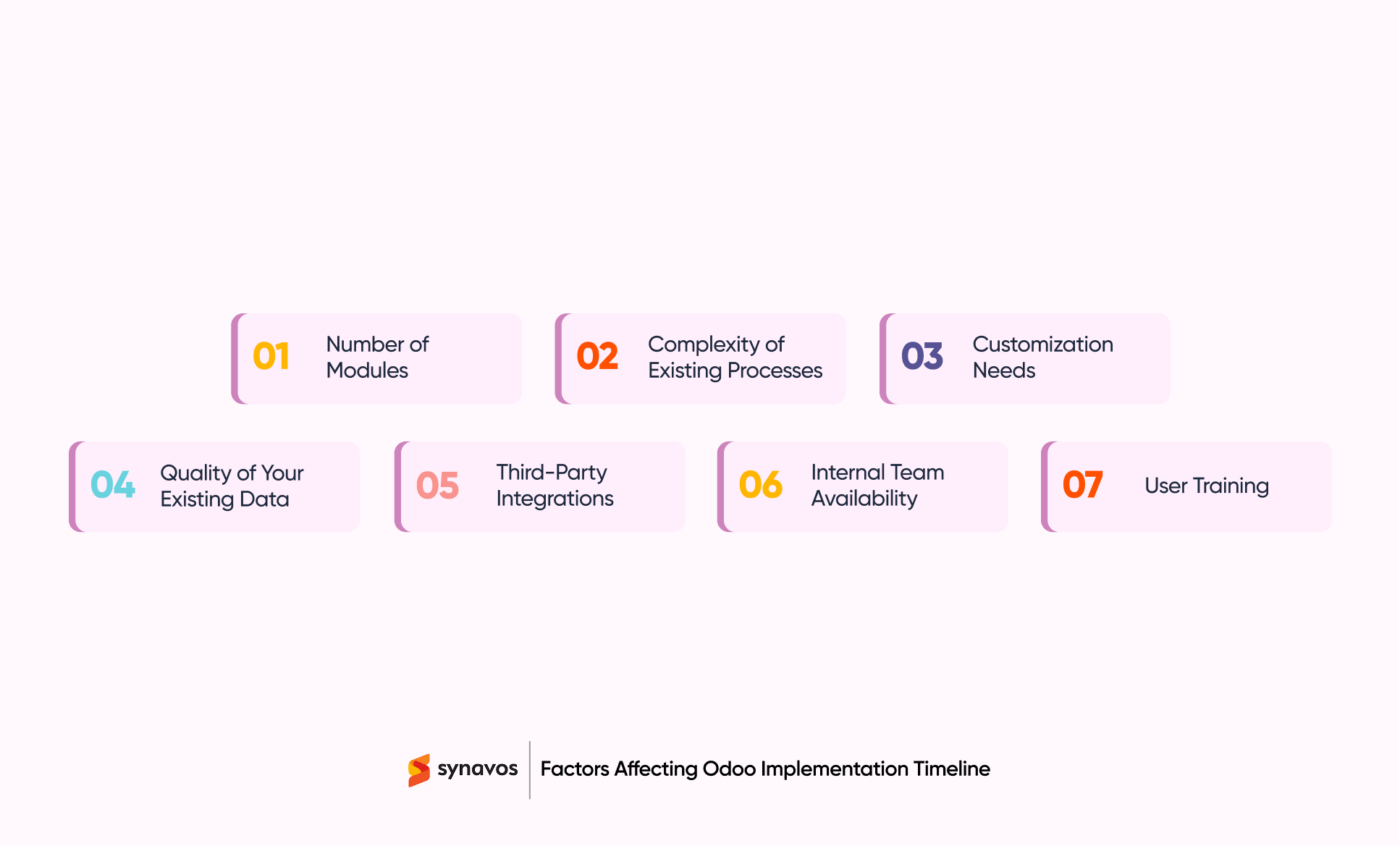
Factors Affecting Odoo Implementation Timeline
Some Odoo projects move quickly. Others slow down. The difference usually comes from a few practical factors.
1. Number of Modules
If you are only implementing CRM and sales, the project is naturally lighter. If phase one includes finance, procurement, inventory, HR, and manufacturing together, the timeline expands.
2. Complexity of Existing Processes
Simple workflows are easier to map into standard Odoo. But if your business has layered approvals, exceptions, region-specific tax logic, multi-location inventory rules, or highly customized reporting, more planning and testing will be required.
3. Customization Needs
Using standard features is generally faster. Custom development adds design time, build time, test time, and future maintenance considerations.
4. Quality of Your Existing Data
Messy data is one of the biggest hidden reasons projects slow down. Duplicate records, missing fields, inconsistent naming, and outdated data all create extra work.
5. Third-Party Integrations
Connecting Odoo to external systems often takes longer than expected, especially if the other systems have limited APIs or complex logic.
6. Internal Team Availability
Many delays come from the client side. If the internal team takes too long to approve workflows, validate requirements, or review testing outcomes, implementation slows down.
7. User Training
Even when the system is technically ready, the business may not be operationally ready. Users need confidence, not just access.
For a detailed look at Odoo ERP implementation costs, check out our full guide: Odoo Implementation Cost: A Complete 2026 Breakdown.
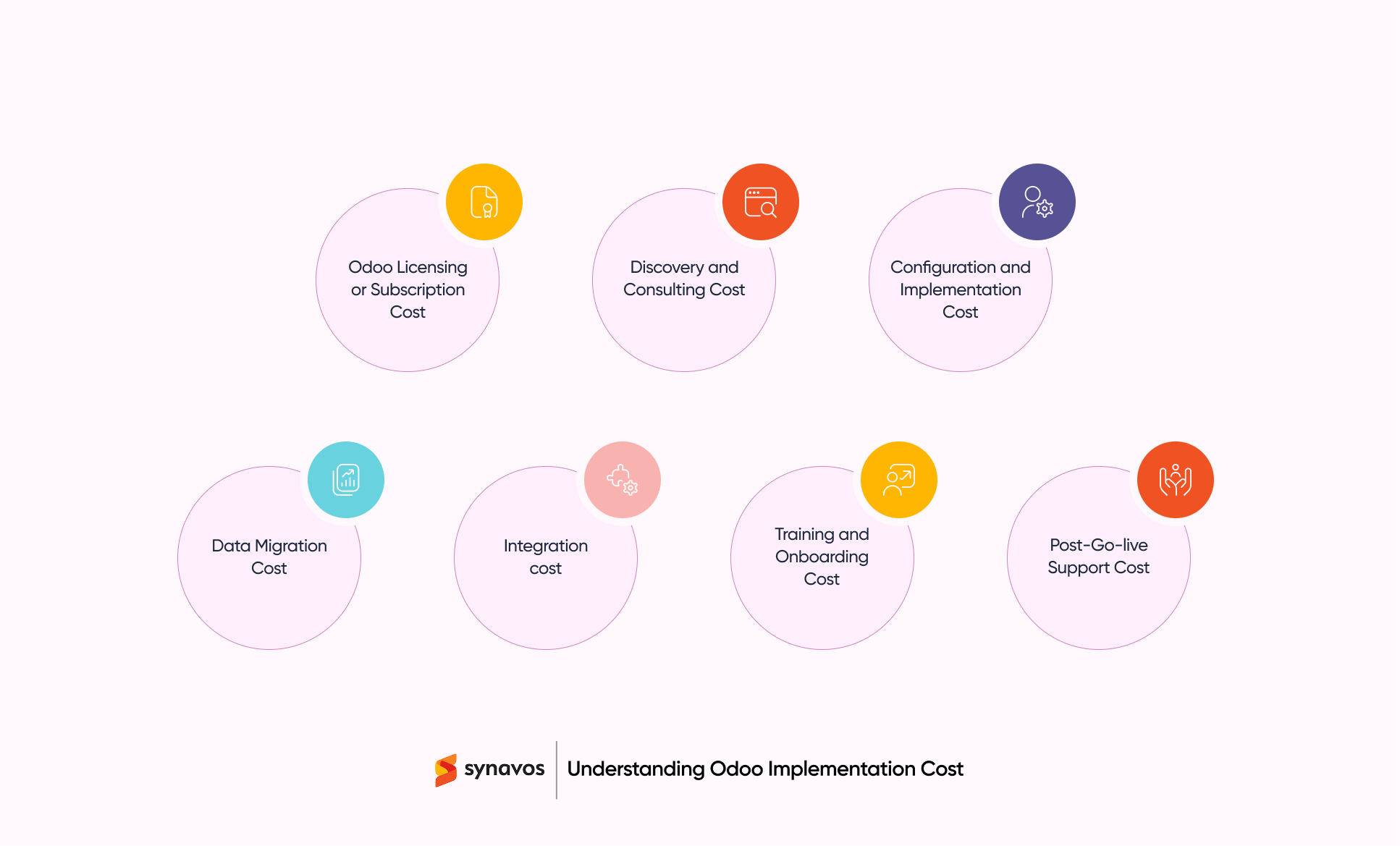
Understanding Odoo Implementation Cost
The second big question is the cost of Odoo implementation. And this is where many businesses become confused, because they assume pricing is mainly about software licensing.
The actual Odoo implementation budget usually includes several cost layers, and software is only one part of the picture.
Odoo Licensing or Subscription Cost
If you use Odoo Enterprise, there may be subscription costs tied to users and applications. If you use a different edition or a specific deployment model, that changes the pricing mix.
Discovery and Consulting Cost
This covers workshops, process analysis, requirement gathering, solution design, gap assessment, and project planning.
Configuration and Implementation Cost
This is the cost of setting up the platform, preparing workflows, configuring modules, defining permissions, and aligning the system with your structure.
Customization and Development Cost
If your business needs custom forms, logic, dashboards, integrations, or workflows, that adds technical effort and budget.
Data Migration Cost
The more data you need to clean, map, test, and move, the more effort is involved.
Integration Cost
Connecting Odoo to other systems can be simple or highly complex, depending on the tools involved.
Training and Onboarding Cost
Good training takes planning and time. It should not be treated as a side task.
Post-Go-live Support Cost
Most businesses need support after launch for stabilization, optimization, and user confidence.
What Increases Odoo Implementation Costs
A lot of Odoo projects do not become expensive because Odoo is inherently unaffordable. They become expensive because scope, decisions, and expectations are not managed well.
Over-Customization
One of the biggest cost drivers is trying to recreate every old process exactly as it existed in the legacy system. Sometimes the smarter move is to simplify the process instead of customizing Odoo to match outdated habits.
Weak Scope Definition
If requirements are not clear at the beginning, new needs keep appearing in the middle of the project. That usually causes rework, timeline extensions, and budget growth.
Poor Data Quality
Bad data creates extra migration effort and often triggers downstream issues during testing and reporting.
Late-Stage Changes
Changes made after solution design or during user acceptance testing are more costly than changes made earlier.
Lack of Internal Ownership
If no one inside the business is making decisions clearly, the project loses momentum and efficiency.
How to Choose the Right Odoo Implementation Partner
Choosing the trusted Odoo partner is one of the most important decisions in the entire project.
A credible Odoo implementation partner like Synavos does more than configure software. They help you understand trade-offs, improve workflows, reduce unnecessary customization, manage risk, train users, and support you after go-live.
Odoo’s official partner program says working with an official Odoo partner like Synavos gives customers access to trained partners, Enterprise source-code access, direct escalation paths to Odoo, and a transparent ranking system. That makes partner quality and positioning an important part of the selection process.
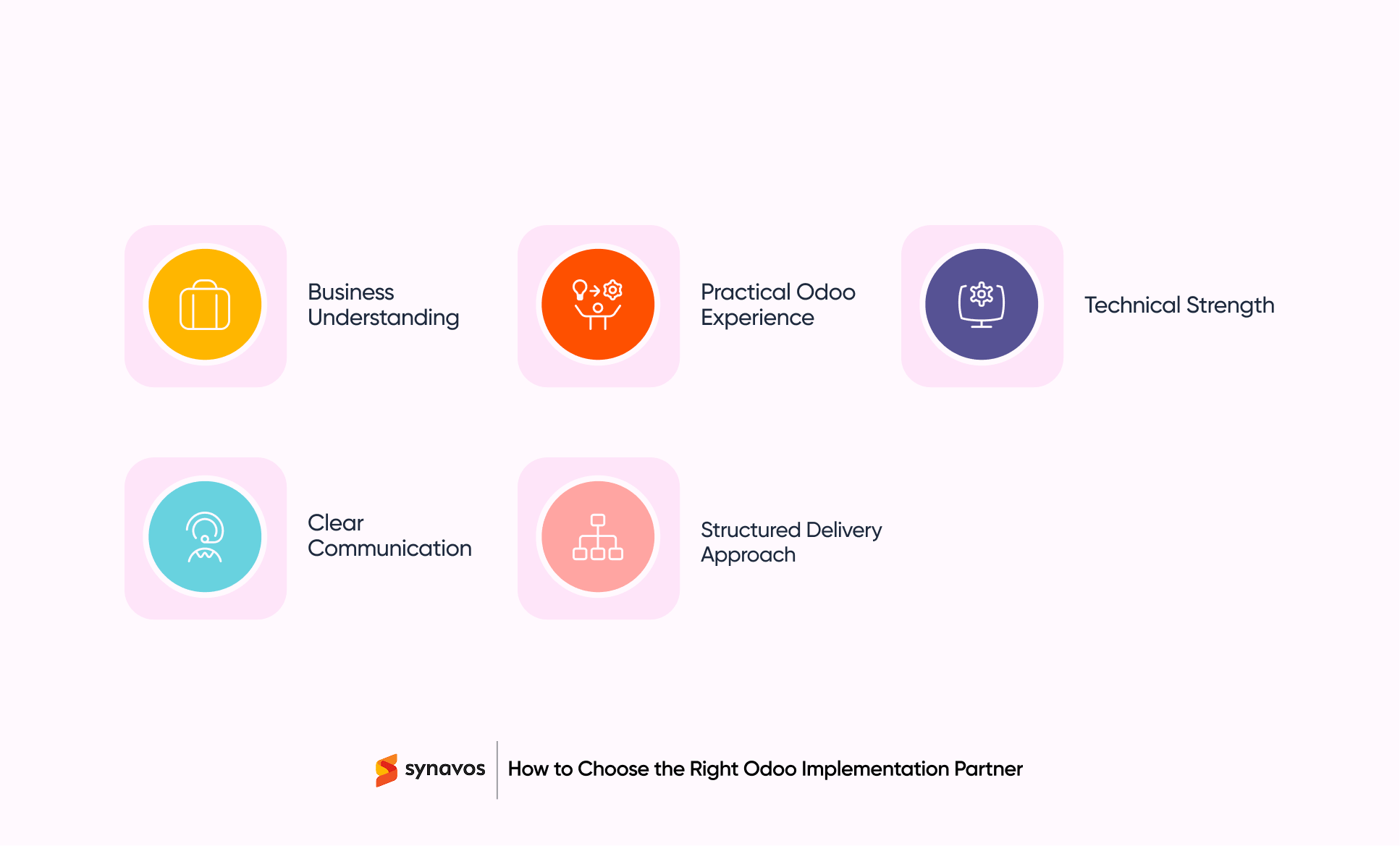
Well, the following is the criteria for selecting a trusted Odoo implementation partner.
Business Understanding
The best partners ask detailed questions about operations, pain points, reporting needs, and future growth. They do not jump straight into quoting development hours.
Practical Odoo Experience
You want a team that has implemented relevant modules and understands real business use cases, not just product features.
Technical Strength
Even if your current needs are modest, your partner should be capable of handling integrations, customizations, upgrades, and future expansion.
Clear Communication
ERP projects go better when expectations are explained simply and honestly.
Structured Delivery Approach
A serious implementation partner should have a defined methodology, milestones, review points, and support plan.
Final Thoughts
Odoo can be a powerful platform for businesses that want to centralize operations, improve visibility, and scale with more control. But software alone does not create results. The real success of the project depends on implementation quality.
If you understand what implementation includes, set realistic expectations on timeline and budget, and choose the right partner, your Odoo project is far more likely to succeed.
What Makes Synavos a Trusted Odoo Implementation Partner?
When looking for the right Odoo implementation partner, it’s clear that technical skills alone won’t cut it. What really matters is finding a partner who understands the business inside and out and can help drive its growth. This is where Synavos, an Odoo Silver Partner, truly stands out. Serving businesses across regions, including Pakistan, the Middle East, and KSA, Synavos doesn’t just offer a one-size-fits-all solution.
With a proven track record of 100+ successful ERP implementations across diverse industries such as manufacturing, retail, healthcare, and education, Synavos has successfully customized Odoo to streamline operations, enhance efficiency, and drive measurable success for its clients.
Contact Synavos today to start your journey toward seamless operations and success.