Many businesses adopt Odoo to streamline operations, only to find that over time, the system becomes increasingly rigid and difficult to manage. What starts as a flexible ERP solution can gradually turn into a complex setup filled with excessive customizations, performance issues, and limitations that slow down growth.
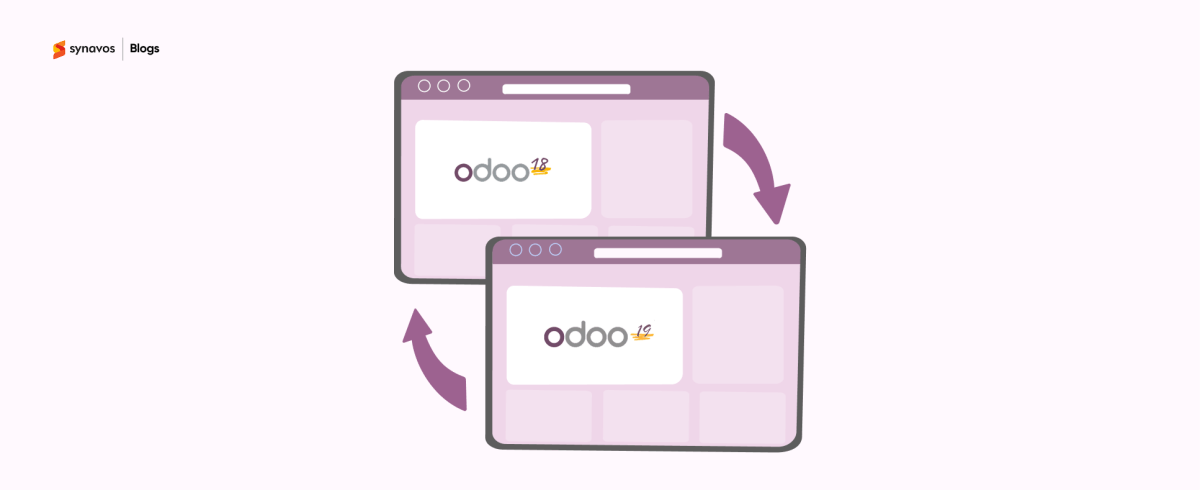
As organizations evolve, their operational needs change. However, systems built on poor initial planning or short-term decisions often fail to keep up. This is where Odoo re-implementation becomes essential. Rather than trying to fix a fragmented system, businesses can rebuild it with a clear focus on flexibility and scalability, ensuring the ERP supports long-term growth instead of restricting it.
Why Customization and Scalability Break in Odoo
Customization and scalability are two of Odoo’s strongest advantages, yet they are also the areas where most implementations fail. One of the primary reasons is poor initial system design. Businesses often rush into ERP implementation without fully defining workflows, resulting in systems that do not align with actual operations. Over time, this leads to inefficiencies and workarounds.
Over-customization is another major issue. While tailoring the system is necessary, excessive or poorly structured custom code creates complexity. This not only slows down the system but also makes upgrades and future changes difficult.
Additionally, many Odoo implementations lack a scalable architecture. As data volume, users, and processes grow, the system struggles to maintain performance. Without proper planning, what once worked efficiently becomes a bottleneck.
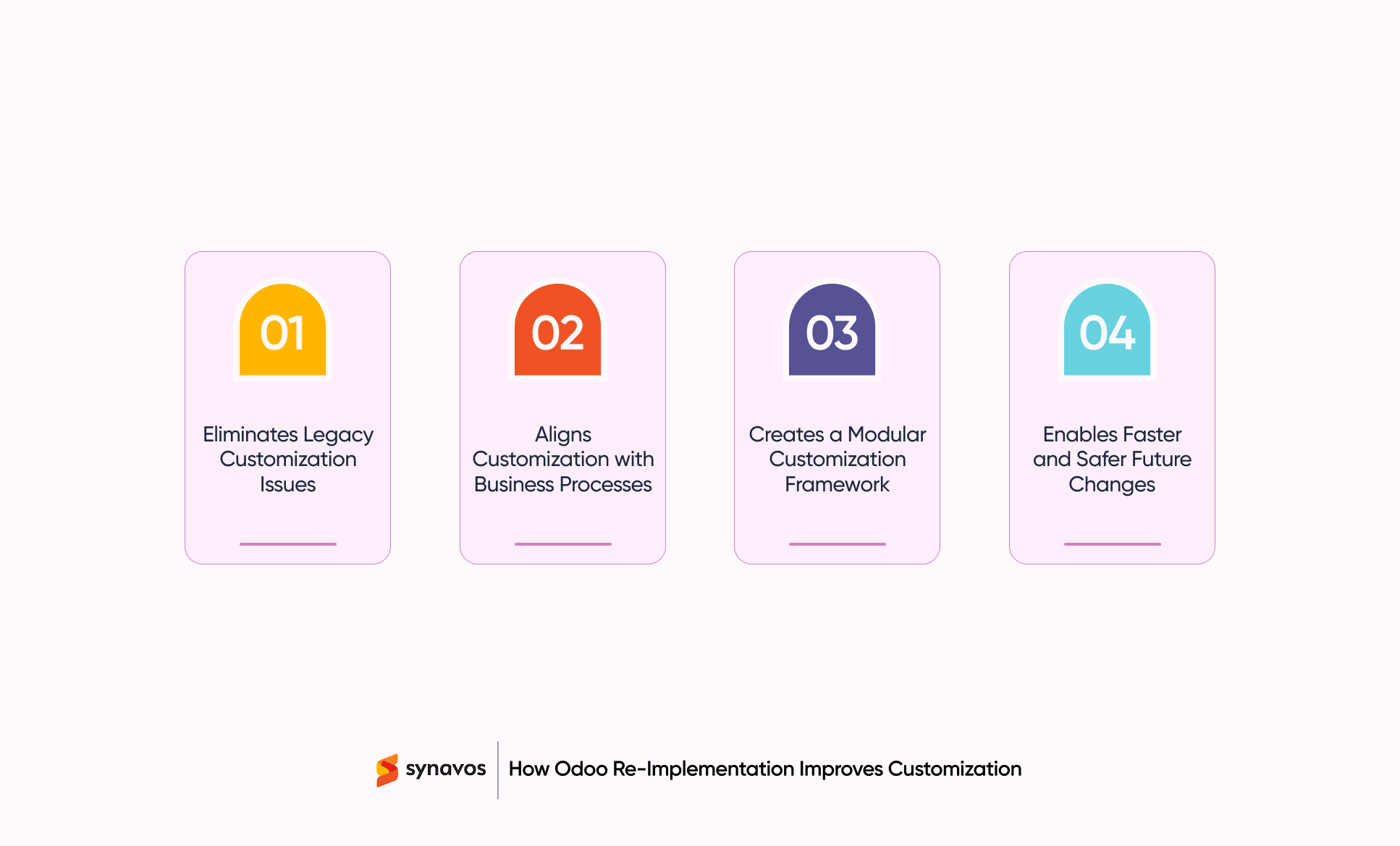
How Odoo Re-Implementation Improves Customization
1. Eliminates Legacy Customization Issues
Re-implementation removes outdated, redundant, or conflicting customizations that have accumulated over time. Instead of building on top of a flawed system, businesses start fresh with a cleaner and more efficient structure.
2. Aligns Customization with Business Processes
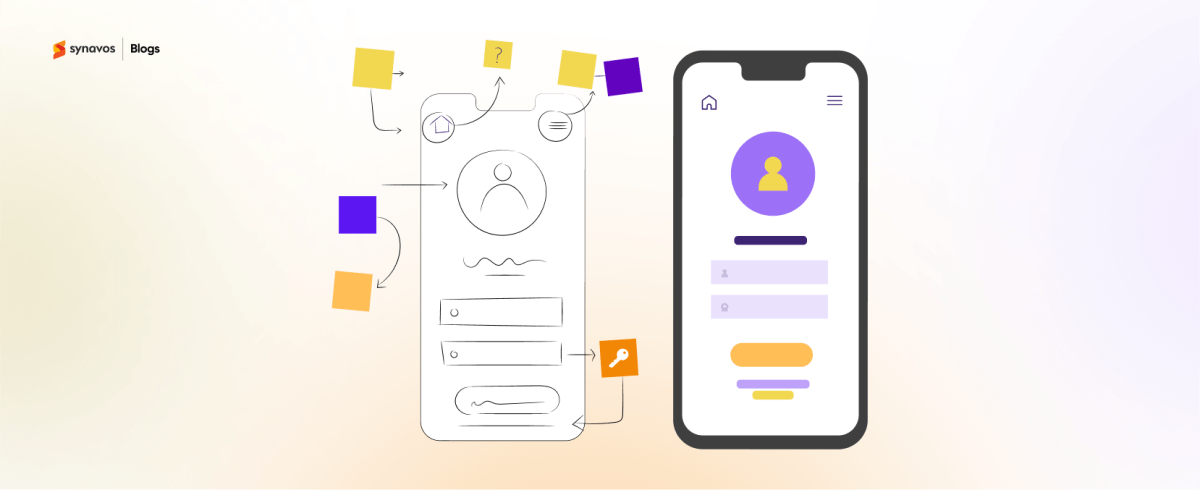
A well-executed re-implementation focuses on actual business needs rather than assumptions made during the initial setup. This ensures that every customization serves a clear purpose and supports operational efficiency.
3. Creates a Modular Customization Framework
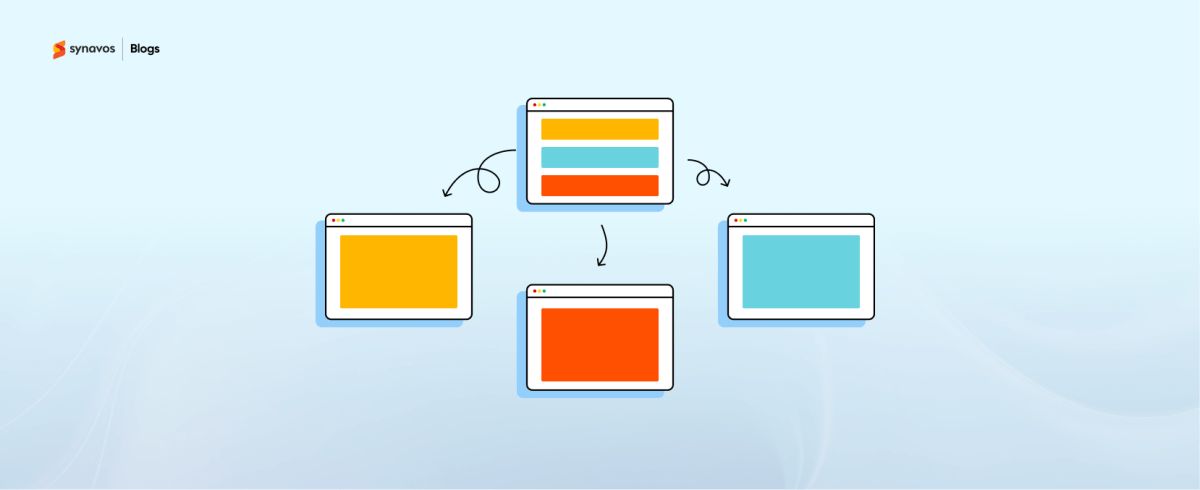
Rebuilding the system allows for a modular approach, where features are structured in a way that is easy to manage and extend. This reduces dependency issues and makes the system more adaptable to future changes.
4. Enables Faster and Safer Future Changes
With a simplified and well-organized system, businesses can introduce new features or modify existing ones without risking system stability. Updates become smoother, and development cycles are significantly faster.
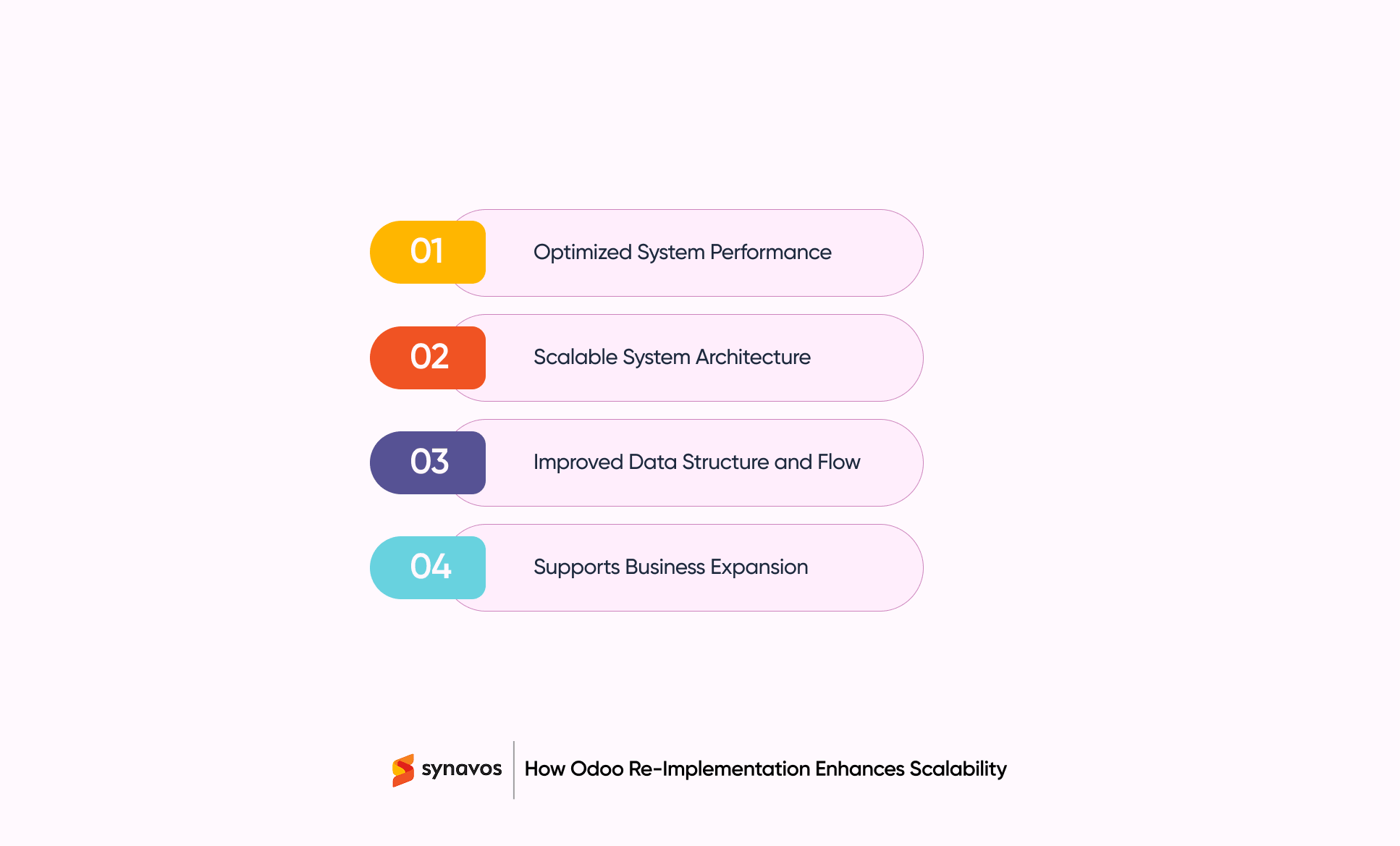
How Odoo Re-Implementation Enhances Scalability
1. Optimized System Performance
Re-implementation improves system performance by removing inefficiencies and optimizing processes. This results in faster response times and a more reliable user experience.
2. Scalable System Architecture
A properly redesigned system is built to handle growth. Whether it is an increase in users, transactions, or data, the architecture supports expansion without compromising performance.
3. Improved Data Structure and Flow
Clean and well-structured data is essential for scalability. Re-implementation ensures that data models are optimized, making reporting, analytics, and decision-making more effective.
4. Supports Business Expansion
As businesses grow, they often need to add new processes, departments, or even enter new markets. A scalable Odoo system makes these transitions smoother, allowing organizations to expand without constantly reworking their ERP.
Why Customization and Scalability Must Be Considered Together
Customization and scalability are often discussed as separate goals, but in practice, they are tightly connected.
A system can be highly customized and still fail if those customizations make it difficult to maintain, upgrade, or expand. On the other hand, a system can be technically scalable but still underperform if it does not match the actual needs of the business.
Odoo re-implementation helps balance both. It allows businesses to retain the flexibility that makes Odoo valuable while creating the structure needed for sustainable growth. That balance is what turns an ERP from a short-term solution into a long-term business asset.
Wrapping Up
Odoo re-implementation is not simply about replacing what already exists. It is about correcting structural issues that limit flexibility, simplifying customization, and creating a system that can support growth with less friction.
For businesses struggling with rigid workflows, excessive custom code, or scaling limitations, re-implementation offers a practical way forward. It helps transform Odoo into a cleaner, more maintainable, and more growth-ready ERP environment.
How Synavos Can Help?
Working with the right Odoo implementation partner also matters. Synavos, as an Odoo Silver Partner, takes a structured, business-focused approach to Odoo re-implementation, helping companies rebuild their ERP around real operational needs rather than outdated assumptions. By focusing on efficient customization and scalable architecture from the start, Synavos has a proven track record of helping businesses move toward an Odoo environment that is easier to manage today and better prepared for tomorrow.
Ready to optimize your Odoo system for customization and scalability? Get in touch with Synavos and take the first step toward a more efficient, future-ready ERP environment.